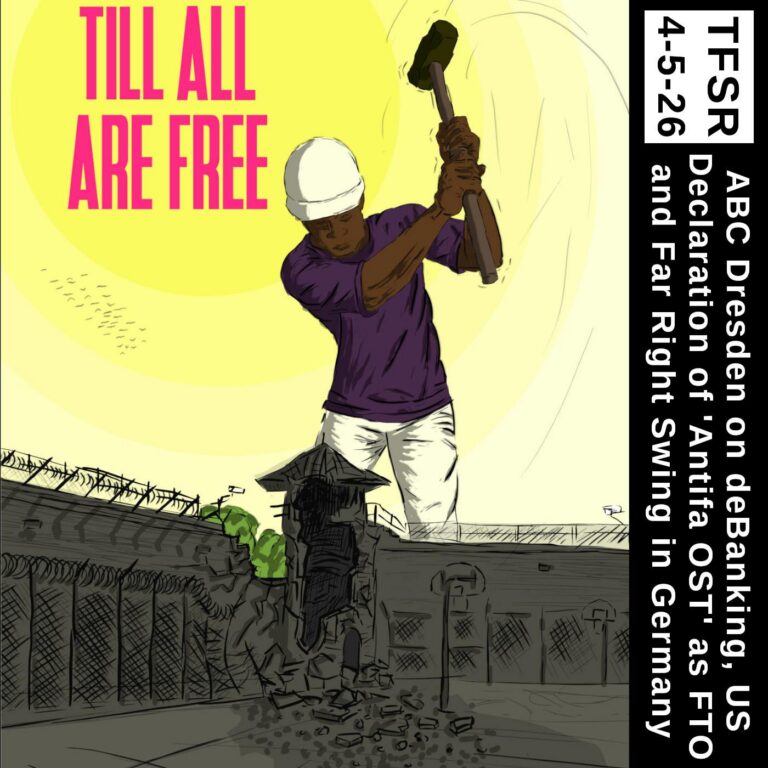
German anti-repression groups have lost banking access, activists face years in prison, and a queer antifascist remains incarcerated in Hungary following an extradition that defied that country’s own constitutional court — these were the central threads of a wide-ranging April 5 episode of The Final Straw Radio, featuring an interview with Nina of Anarchist Black Cross (ABC) Dresden.
The episode is the second in recent weeks to examine the Trump administration’s counterinsurgency strategies against antifascist movements, sitting alongside last week’s interview on the Prairieland case in Texas. The show connects those U.S. developments to cascading effects in Europe.
ABC Dresden and the Debanking Campaign
Anarchist Black Cross Dresden has operated for over a decade as a prisoner support and anti-repression solidarity group, with a historic focus on supporting comrades in Eastern Europe — Belarus, Russia, Ukraine, and Poland. Since Russia’s full-scale invasion of Ukraine in 2022, the group has shifted significant resources toward solidarity with Ukrainian comrades.
Nina explained that ABC Dresden and numerous other German anti-repression groups were swept up in a debanking wave in December 2025, after the Trump administration’s National Security Presidential Memorandum 7 (NSPM 7) designated a group called “Antifa Ost” as a foreign terrorist organization. That designation placed Antifa Ost on international sanctions lists — sanctions lists that banks are obligated to screen against as a condition of participation in global payment systems like SWIFT.
“The reason behind [debanking] are not necessarily political, but the decisions about what is a risk — this is highly political,” Nina said. Banks, she explained, engage in what the industry calls “de-risking”: proactively closing accounts to avoid potential regulatory scrutiny or reputational harm, often without disclosing their reasons to the account holders. “They often don’t even tell the reason. That means you cannot really fight back, because you don’t even know what you’re fighting against.”
The affected groups had accounts at GLS Bank, a German cooperative bank that markets itself on ecological and social values, and that holds accounts for a wide array of left-wing organizations — housing syndicates, agriculture cooperatives, and cultural projects. When the debanking became public, thousands of GLS members mobilized pressure on the institution.
The result was uneven. Large organizations with significant membership — like Rote Hilfe (Red Aid), which had approximately 60–70 regional accounts — were able to negotiate partial retention. Rote Hilfe ended up with a handful of centralized accounts and was required to sanitize transaction subject lines, avoiding references to “Antifa Ost” since that term now triggers automated banking algorithms. Smaller initiatives like the one through which ABC Dresden operated got no such accommodation. “Debanked is debanked. We don’t talk about that,” Nina said, describing the bank’s posture toward smaller groups. “We don’t have a bank account anymore right now which we can use publicly.”
The Antifa Ost Case: A Police Construct Goes International
Nina described Antifa Ost as a construct: a criminal organization defined by police and prosecutors rather than a coherent group that defined itself. Under Germany’s Paragraph 129 — the criminal organization statute, which was significantly hardened in 2017 — prosecutors do not need to prove that an individual participated in specific illegal acts. Membership or support for the defined organization is sufficient for prosecution.
“It’s not that you have to be part of this kind of movement in general or that you kind of actually support the actions or the ideas — rather, it’s enough that the person was in touch with somebody else,” Nina said. That breadth allows investigators to surveil entire movements, not just suspected individuals.
The first round of Antifa Ost prosecutions resulted in sentences of two to four and a half years. The second round is ongoing — since November in Dresden — involving different defendants and different alleged incidents, including attacks on neo-Nazis in Thuringia.
The U.S. designation of Antifa Ost as a foreign terrorist organization had immediate downstream consequences in Europe. Hungary also designated Antifa as a terrorist organization. “People were caught a bit by surprise,” Nina said. “It was clear that something will happen, but [the effect was] really fast.”
The Budapest Complex: International Anti-Fascist Prosecutions
Running in parallel to the Antifa Ost proceedings is what Nina called the Budapest complex — two overlapping legal cases sharing some defendants.
Every February 11, Budapest hosts what its organizers present as a commemorative hike: a reenactment of a 1945 episode in which German Wehrmacht forces and Hungarian collaborators attempted to break through Red Army encirclement and failed. It has become one of the most significant gatherings of European neo-Nazi networks, drawing militants from across the continent to a city where Nazi-adjacent symbols are more permissible than in Germany.
“It’s funded by the tourist administration. There’s families joining. You have Nazis with uniforms and Nazi symbols next to the families in pink hiking outfits, and they all go together doing this hike,” Nina said.
Anti-fascist counter-mobilization against the event grew over years, drawing participants from across Europe. In 2023, a group including several people from Germany chose to directly confront neo-Nazi participants. Budapest is, Nina noted, one of the most heavily surveilled cities in Europe — cameras tracked the counter-protesters, Hungarian police and media published identifying information, and neo-Nazi networks amplified it into Germany.
One of the first arrested in Germany was an Italian anti-fascist, Ilaria Salis, who became publicly prominent for publishing accounts of harsh conditions in Hungarian detention. She later ran on an Italian left-wing party list and won a seat in the European Parliament — which provided her sufficient legal protection to be released from Hungarian custody.
A queer German activist known as Maya had a different trajectory. After spending time underground to avoid extradition to Hungary — at one point more than ten people were living underground to avoid the same fate — Maya was arrested in Berlin in 2024 and held for six months in Dresden. Despite the German Federal Constitutional Court ruling that extradition was impermissible, Germany’s criminal police transferred Maya by helicopter to the Austrian border and handed Maya over to Hungarian authorities anyway.
In January, Maya was sentenced to eight years in Hungarian prison — the prosecution had sought 24. An appeal is pending. “They couldn’t prove any of the accusations they actually made against Maya,” Nina said.
A separate trial is underway in Düsseldorf for a larger group of people who eventually surfaced from underground and surrendered to German authorities, having sought — but not received — guarantees that they would be tried in Germany rather than extradited. How those proceedings will resolve is still unclear.
Germany’s Rightward Trajectory
Nina characterized the broader political environment in Germany not as a simple rightward drift — the German word rechtsruck — but as what she called “fascistization”: the building of authoritarian structures across institutions over time.
She cited: expanded surveillance and predictive policing; rounds of tightened police laws in multiple federal states; the German domestic intelligence service (Verfassungsschutz) labeling groups as “extremist” and using that designation to cut funding from NGOs that collaborate with them; and a rightward shift in public discourse that has preceded formal right-wing electoral gains.
On the morning of the recording, Nina noted, there had been 18 police raids across Germany — 15 in Berlin, three elsewhere — related to alleged sabotage of critical infrastructure, including power outages in parts of Berlin in recent months.
She also described a “culture war” targeting liberal and left institutions: book fair nominations contested because a published work was connected to groups the Verfassungsschutz considered extremist; and a 2025 episode in which conservatives successfully blocked the election of a candidate to the Federal Constitutional Court by weaponizing her position on abortion rights, despite her widely recognized qualifications. “The liberals are not even able to protect the democracy they are so proud of,” Nina said.
A recent survey showing German Gen Z holding notably conservative views alarmed her, as did what she described as a surge in anti-Ukrainian sentiment among the German population — a stark reversal from the solidarity that accompanied the early months of Russia’s 2022 invasion. German-language courses for Ukrainian refugees have since been cut.
Nina drew historical parallels to Nazi organizational strategy in the 1920s and 1930s, when the party built rural strongholds before moving into cities. “This is something which actually works again,” she said.
How to Follow and Support
ABC Dresden can be found at abcdd.org, as well as on Instagram and Mastodon. The group still accepts PayPal donations through its website. For the Budapest complex case specifically, Nina directed listeners to basc.news (Budapest Anti-Fascist Solidarity Collective). Maya’s case specifically is tracked by the free.maya Instagram account.
Nina’s closing advice to listeners: take digital security seriously now — encrypt devices, be careful with whose information you handle and how — and build anti-repression capacity before it is needed, not after.
“We have a clear and strong attack on any kind of structures, ideas, or values which are liberating or have progressive ideas,” she said. “For that, we really have to organize and prepare better and well.”
The Final Straw Radio airs on Asheville FM 103.3 LPFM and is archived at thefinalstrawradio.noblogs.org. The show is a member of the Channel Zero Network of anarchist podcasts.