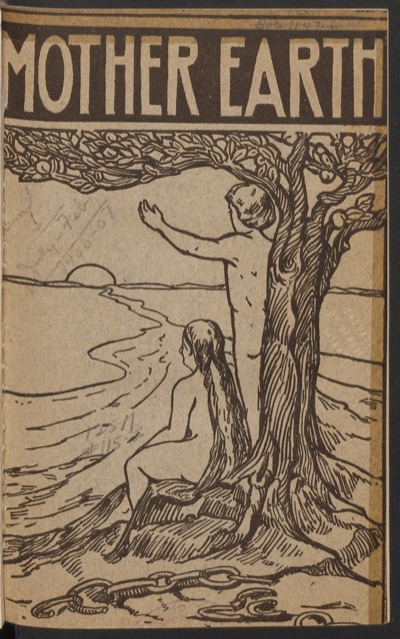
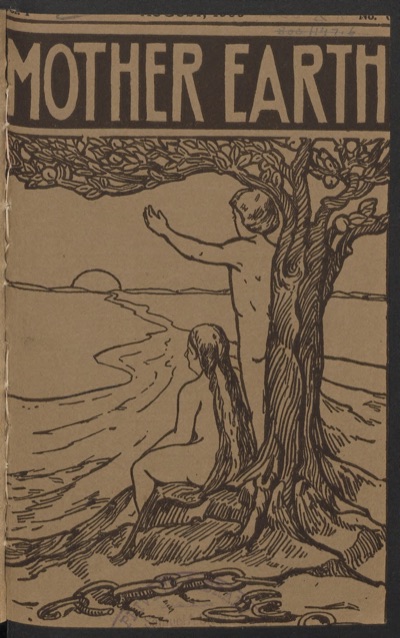
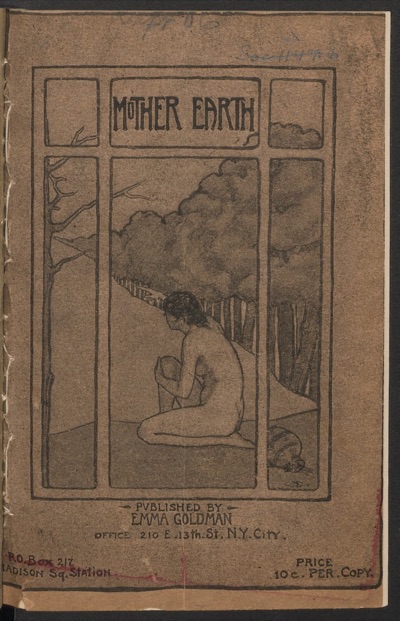
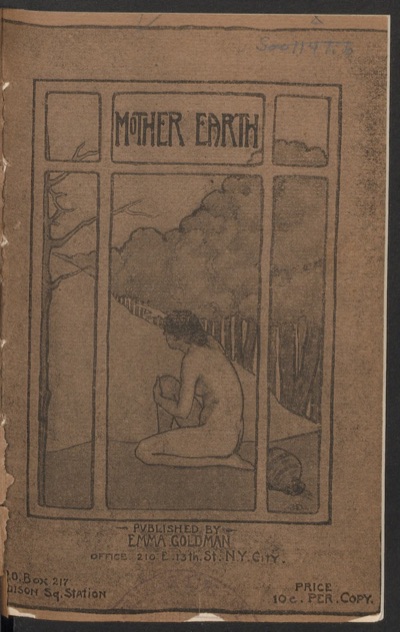
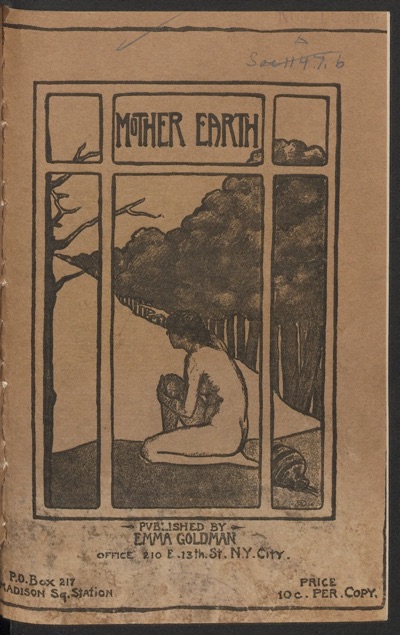
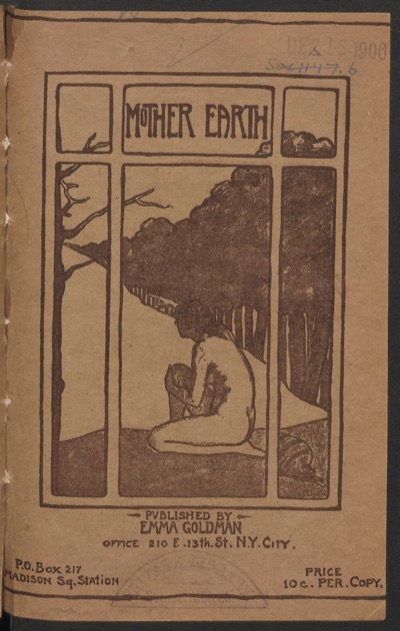
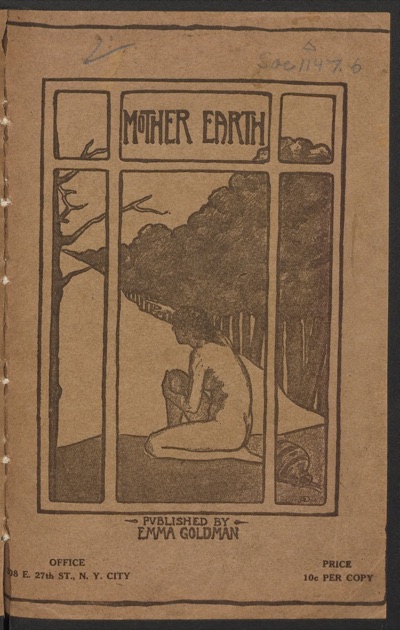
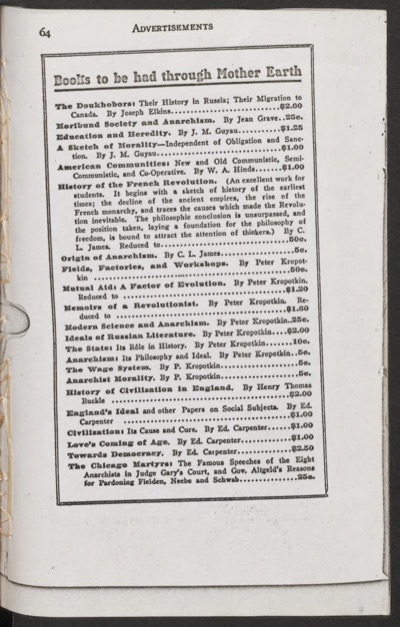
Mother Earth was an anarchist monthly founded by Emma Goldman in March 1906 and published from New York until the Post Office suppressed it in August 1917 under the Espionage Act. Goldman edited it first with Max Baginski and later with Alexander Berkman, running anarchist argument alongside poetry, drama and literary criticism, and covering free speech, birth control, labor struggles and the case against conscription.
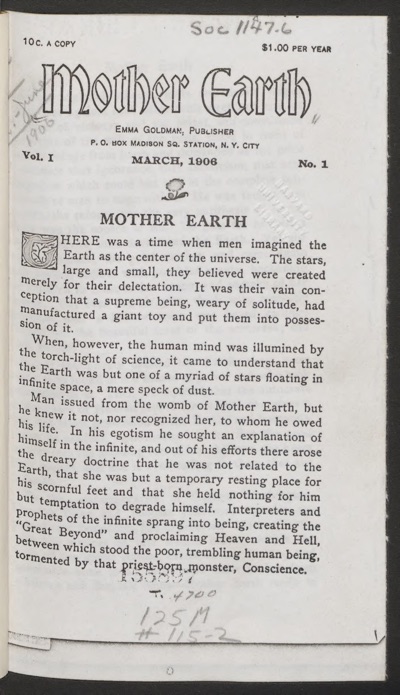
The inaugural issue of Mother Earth, edited by Emma Goldman and Max Baginski, opens with the magazine‘s founding essay and runs through Goldman‘s “The Tragedy of Woman‘s Emancipation,” Baginski‘s “Without Government,” reporting on the Russian Revolution, and the opening of the Moyer-Haywood-Pettibone frame-up in the Colorado mining wars.
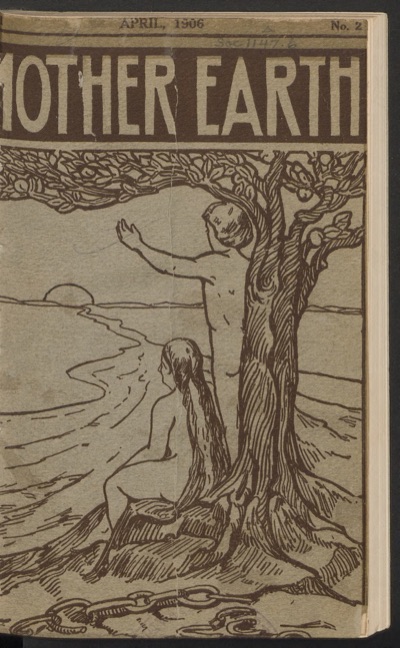
The second issue of Mother Earth, dominated by the death of Johann Most, who died in Cincinnati on March 17, 1906, weeks after Philadelphia police broke up his sixtieth-birthday meeting. Emma Goldman leads with “The Child and Its Enemies,” an argument that family, school and state alike grind children into patient work slaves; John R. Coryell calls marriage “legalized prostitution“; L. I. Peretz warns his fellow radicals that victorious revolutionaries make the next bureaucracy; and the Observations column takes up the Colorado mine wars and the prosecution of Haywood, Moyer and Pettibone.
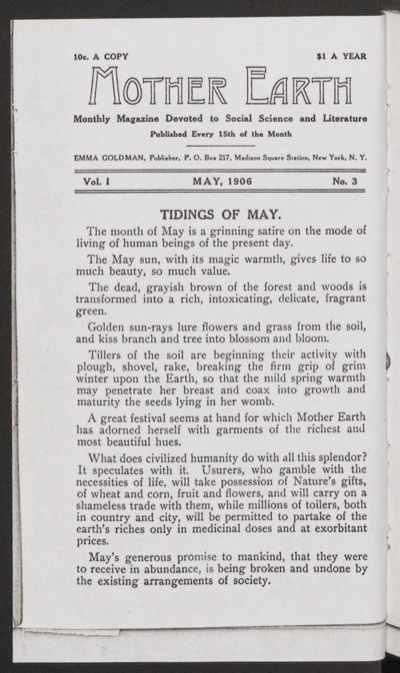
The third issue of Mother Earth, published as Alexander Berkman prepared to walk out of the Hoboken workhouse after fourteen years, and Emma Goldman, signing herself E. G., retells the Homestead strike that put him there. The issue takes up the Gorky scandal twice over: Margaret Grant‘s satire “This Man Gorky” invents a Woman‘s Association for the Regulation of the Morals of Others to skewer the clubwomen who demanded his deportation, and Gorky‘s own sketch “Comrade” follows immediately after. Voltairine de Cleyre contributes a sonnet to the Czar and an obituary for the Norwegian anarchist Kristofer Hansteen; Max Baginski walks the starving weaving villages of Silesia with Gerhart Hauptmann; and the Observations column measures the charity poured on San Francisco after the earthquake against the poverty the city ignored before it.
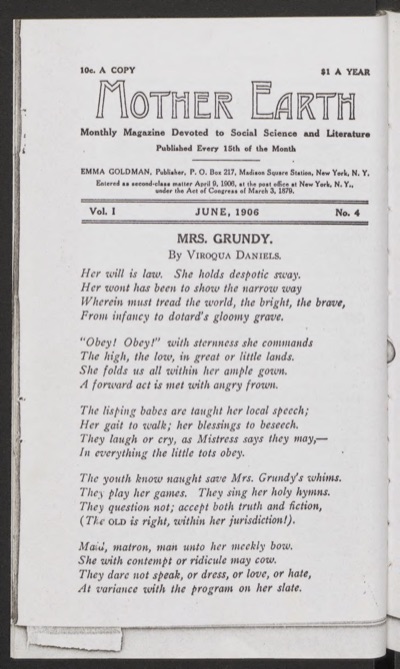
The June issue leads with Alexander Berkman‘s first public words after fourteen years in the Western Penitentiary, a greeting that finds the world‘s inventions changed and its cruelties intact. Max Baginski, signing himself M. B., writes Henrik Ibsen‘s obituary, and returns later in the issue with a long attack on the tactics of the American trade unions. Emma Goldman writes in from her Chicago tour, teasing her editor about the marriage the newspapers invented for her and about the police chief who ordered his men out of uniform rather than let her mock them. Also in this number: Viroqua Daniels on Mrs. Grundy, Peter Kropotkin on brain work and manual work, Henriette Fuerth on motherhood and marriage, pages from Nietzsche‘s “Antichrist,” Arthur G. Everett on the soldiers who shot San Franciscans in the ruins of the earthquake, Anna Mercy on the cruelties civilization has refined rather than abolished, and a review of Upton Sinclair‘s “The Jungle.”
The July issue leads with Kropotkin surveying the Russian Revolution‘s grim spring and the Duma elections that followed it, and with Emma Lee questioning the fetish of the “survival of the fittest.” An excerpt from Oscar Wilde‘s “De Profundis” runs alongside a sheaf of anti-militarist letters from an American farmer and a maimed German veteran, Max Baginski continues his June essay on the aims and tactics of the trades-union movement, and Alvan F. Sanborn surveys the revolutionary temper running through Tolstoy, Ibsen, Zola, Anatole France, and a long list of lesser-known French novelists. Also in this number: a satire on Anthony Comstock caught confiscating his own image, Turgenev‘s sketch of two friends debating whether a beaten man deserves rescue, and M. B.‘s story of two department-store clerks worn down by the daily grind of work into a love neither can afford.
Emma Goldman opens the August number with a character study of Russell Sage, the financier who left behind a hundred million dollars and who, unlike the dilettant philanthropists Carnegie and Rockefeller, never donned the garb of beneficence; she recalls the secretary he put between himself and a visitor‘s bomb, left a cripple for life, whose case against him was still pending in the courts. Alexander Berkman follows with “Prisons and Crime,” compiled, a footnote says, from notes he made in prison in 1895, arguing that the prison retrogrades rather than advances its own purpose and that the money spent on it would do as much good sunk in the Atlantic. Peter Kropotkin begins “Modern Science and Anarchism,” the first installment of a long essay holding that anarchism was born among the people and not in the universities, and that it belongs with the inductive method of the natural sciences rather than with metaphysics. Alvan F. Sanborn continues his survey of the revolutionary spirit in French literature, through Zo d‘Axa, Mirbeau and the little reviews of Paris. Also in this number: Nietzsche on morality as antinaturalness in Alexander Tille‘s translation, a passage from Zola‘s “Labor” in which the dying Luc Froment looks out on a regenerated world where the last battle has been fought and war is dead, Turgenev‘s “The Beggar,” Margaret Grant on modesty as a convention that varies with every country and keeps women ignorant and ill, aphorisms by J. M. Gottesman, poems by Milo A. Townsend and Valter, and the unsigned story “The Triumph of Youth.”
Voltairine de Cleyre opens the September number with a scorching open letter to Maxim Gorky, denouncing his conduct on his fundraising tour of America. Peter Kropotkin continues “Modern Science and Anarchism,” tracing the synthetic philosophies of Auguste Comte and Herbert Spencer and their failure to escape metaphysics when they reached the study of society. H. Kelly measures New York‘s ward politicians against Aristotle‘s Ethics, Alexander Berkman announces a lecture tour on prisons, and Max Baginski‘s satirical “Anthony B. Comstock‘s Adventures” imagines the vice crusader pursued by nudity in a museum, a nightmare, and his own bathroom. A. T. Heist‘s “The Procurer‘s Assistant” traces prostitution to starvation wages rather than to the procurer alone, and de Cleyre reviews Jas. F. Morton‘s “The Curse of Race Prejudice” and Morrison Swift‘s “Marriage and Race Death.” Georg Brandes surveys Henrik Ibsen‘s place among Taine, Tolstoi, and Nietzsche, and Alvan V. Sanborn continues his survey of revolutionary currents in French literature, through Mirbeau, Descaves, Donnay, Courteline, and Brieux. Also in this number: David Diamondstein‘s poem “A Toiler‘s Plaint,” an appeal to fund publication of C. L. James‘s “Vindication of Anarchism,” and Sadakichi Hartmann‘s short story “The Little Wayside Station.”
The October number is given largely to the fifth anniversary of Leon Czolgosz‘s shooting of President McKinley: Max Baginski recalls his one chance meeting with Czolgosz and defends his memory, Emma Goldman reprints her 1901 essay “The Tragedy at Buffalo” on the psychology of the act, and Alexander Berkman contributes a prose-poem, “A Reminiscence,” from his own cell. Peter Kropotkin concludes “Modern Science and Anarchism,” arguing that law only ever crystallizes customs the masses had already worked out for themselves, and defining Anarchism‘s debt to Godwin, Proudhon, and the First International. A. Derlitzki tells the story of “Angiolino,” a fellow London compositor who turns out to be the assassin of Spain‘s Prime Minister Cánovas del Castillo, and T. del Marmol reports on the persecution of Francisco Ferrer and his Modern School. Also in this number: a symposium of reports on the failure of state-socialist and compulsory-arbitration legislation in New Zealand and Australia, I. Knox on “Class-Conscious Politics,” Bolton Hall on liberty for prisoners, Alice Stone Blackwell‘s poem “The Streamlet,” and Voltairine de Cleyre‘s story “Between the Living and the Dead.”
Emma Goldman opens with a first-hand account of “Police Brutality” at a Ferrer Association meeting broken up on the pretext of discussing whether Czolgosz was an Anarchist, and closes with a note reassuring readers that Alexander Berkman‘s disappearance was not a kidnapping but a needed retreat. H. Kelly commemorates the Chicago martyrs on the eleventh of November, and William Holmes answers a Collier‘s attack on “Anarchists of America” point by point. Margaret Grant‘s dialogue “What is Morality?” walks a Bible-quoting friend through the double standard by which murder and theft become patriotism, trade, and industry once the state or the capitalist commits them. Peter Kropotkin continues “Modern Science and Anarchism,” applying the natural-scientific method to political economy and to the State itself. Also in this number: a letter from the Russian Anarchists on the movement‘s rapid growth since 1903 and the controversy over “expropriation,” an International Notes roundup from Russia, France, Germany, Bohemia, Corsica, Spain and Holland, Emma Lee‘s ironic sketch “The Rebellion of Alvira,” and Sadakichi Hartmann‘s “Unexpected Charity.”
Emma Goldman reports on the magazine‘s own year of police persecution: raided meetings, a confiscated issue, and a Sustaining Fund opened against the possibility of her own arrest and imprisonment. Theodore Schroeder‘s “Our Vanishing Liberty of the Press” surveys the immigration and criminal-anarchy laws that would exclude Tolstoy, Kropotkin, and by his account Jesus himself from the United States, and the magazine prints the new New York “Criminal Anarchy” law in full. Goldman, Berkman, and H. Kelly jointly answer E. C. Walker‘s attack on the Czolgosz discussion meeting. Peter Kropotkin concludes “Modern Science and Anarchism,” arguing that revolutions are made from below by accumulated popular revolt, never handed down by parliaments or provisional governments. H. Kelly writes on the imprisonment of English suffragettes apropos of woman suffrage, and Charles Mierzwa surveys the life and novels of Gustave Flaubert. Also in this number: J. F. Phillips‘s confession “Parasitism,” an International Notes roundup from a dozen countries, and William Mountain‘s and John Francis Valter‘s poems.
Emma Goldman reports the arrest of herself, Alexander Berkman, and John R. Coryell for a talk on the aims of the “Mother Earth” Club, and announces a lecture tour to shore up the magazine‘s Sustaining Fund. Theodore Schroeder‘s “On Suppressing the Advocacy of Crime” argues from a stenographic lecture that the Constitution protects the advocacy of any idea, however criminal its tendency, so long as no resulting act follows. Voltairine de Cleyre, invoking her late friend Dyer D. Lum, defends the anarchists of deed against the movement‘s purists; Elizabeth Burns Fern reads Whitman as the poet of democratic equality; and Bolton Hall answers Goldman on the ethics of revolutionary violence. Also in this number: a satirical open letter to Anthony Comstock signed “Maria Muggins,” the conclusion of Charles Mierzwa‘s study of Flaubert, and Maxim Gorky‘s graveyard dialogue with Satan, “The Masters of Life.”
Marking the magazine‘s first anniversary, Emma Goldman‘s “Observations and Comments” surveys a year of police persecution and needles Secretary Shaw‘s talk of prosperity, the Moyer-Haywood kidnapping, and H. G. Wells‘s statist vision of motherhood; her “Among Barbarians” indicts American parochialism toward revolutionary ideas abroad. Leonard D. Abbott remembers the recently deceased Ernest Crosby, and H. Kelly memorializes the English comrade Thomas Cantwell. Elisabeth Burns Ferm concludes her reading of Walt Whitman as the poet of democratic equality, and the young Nicholas Kopeloff‘s schoolboy essay claims John Brown for the anarchist tradition. The issue reprints an appeal for the International Libertarian and Communist Labor Congress to be held at Amsterdam in 1907, reviews Dexter Wallace‘s “The Blood of the Prophets” and Jack London‘s “White Fang,” and closes with an International Notes roundup from England, France and Germany, accountings of the Free Speech Defense Fund and the Sustaining Fund, and a translated Yiddish sketch, “The Child‘s Question,” about a striker‘s hungry child.