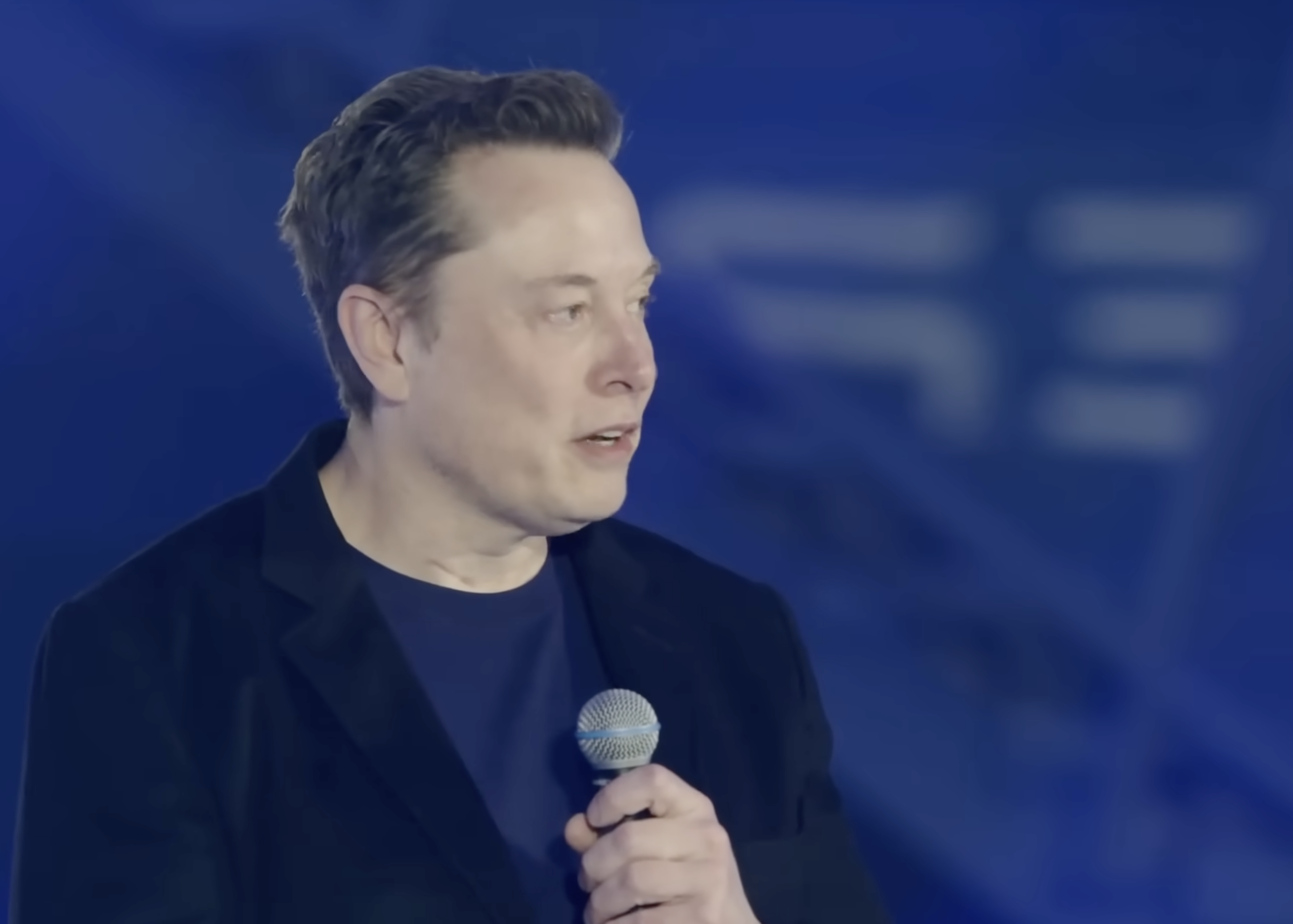
Elon Musk was born in Pretoria, South Africa, on June 28, 1971. Three years earlier and seven thousand miles north, the Thiel family had emigrated from West Germany to the United States; in 1971, they relocated again — to South Africa and then to South West Africa, modern-day Namibia, where Peter Thiel attended a German-language school in the coastal town of Swakopmund. The German community in Swakopmund at the time was “known for its continued glorification of Nazism.” The school required uniforms and used corporal punishment.
Musk’s formative years were spent inside the apartheid system itself. His maternal grandfather, Joshua Haldeman, an American-born Canadian chiropractor and political activist in the 20th-century Technocracy movement, immigrated to South Africa in 1950 — just as the most aggressive apartheid laws were being codified. Haldeman, according to Musk’s father Errol, was a Nazi sympathizer, and historians describe him as a “fanatical” supporter of apartheid who promoted antisemitic conspiracy theories.
Reporter Chris McGreal, who covered South Africa as The Guardian’s Johannesburg correspondent, told Democracy Now! that Haldeman arrived as laws “reminiscent of the Nazi Nuremberg laws” were taking hold. Musk himself eventually applied for a Canadian passport — through his Saskatchewan-born mother — in part to avoid mandatory South African military service, which would have required him to enforce the apartheid regime he later left behind.
In Muskism: A Guide for the Perplexed, co-authors Quinn Slobodian and Ben Tarnoff argue that this milieu — what they call “fortress futurism” — is the ideological operating system now running through Musk’s companies and his politics.
“Late apartheid South Africa is kind of a perfect prototype for this version of organizing society,” said Slobodian, a professor of international history at Boston University. “It was a very backward place politically, explicitly engineered to reinforce racial hierarchies, but they were also a very high-tech country — importing nuclear technology, using IBM mainframes to conduct the practice of apartheid, building out their own auto industry.”
That combination — hierarchical racial control fused with technological self-sufficiency — is, Slobodian argues, the template Musk now sells: a “civilizationally hierarchical, technologically enabled enclave approach to the world.” Thiel, in interviews, has framed his own boyhood in southern Africa as the source of his “distaste for uniformity and regimentation,” a phrasing that turns the same biography into a libertarian origin story rather than a fortress one. The two narratives diverge on the surface; the underlying instincts — civilization is fragile, hierarchy is realistic, the future belongs to those who can build their own enclave — are nearly identical.
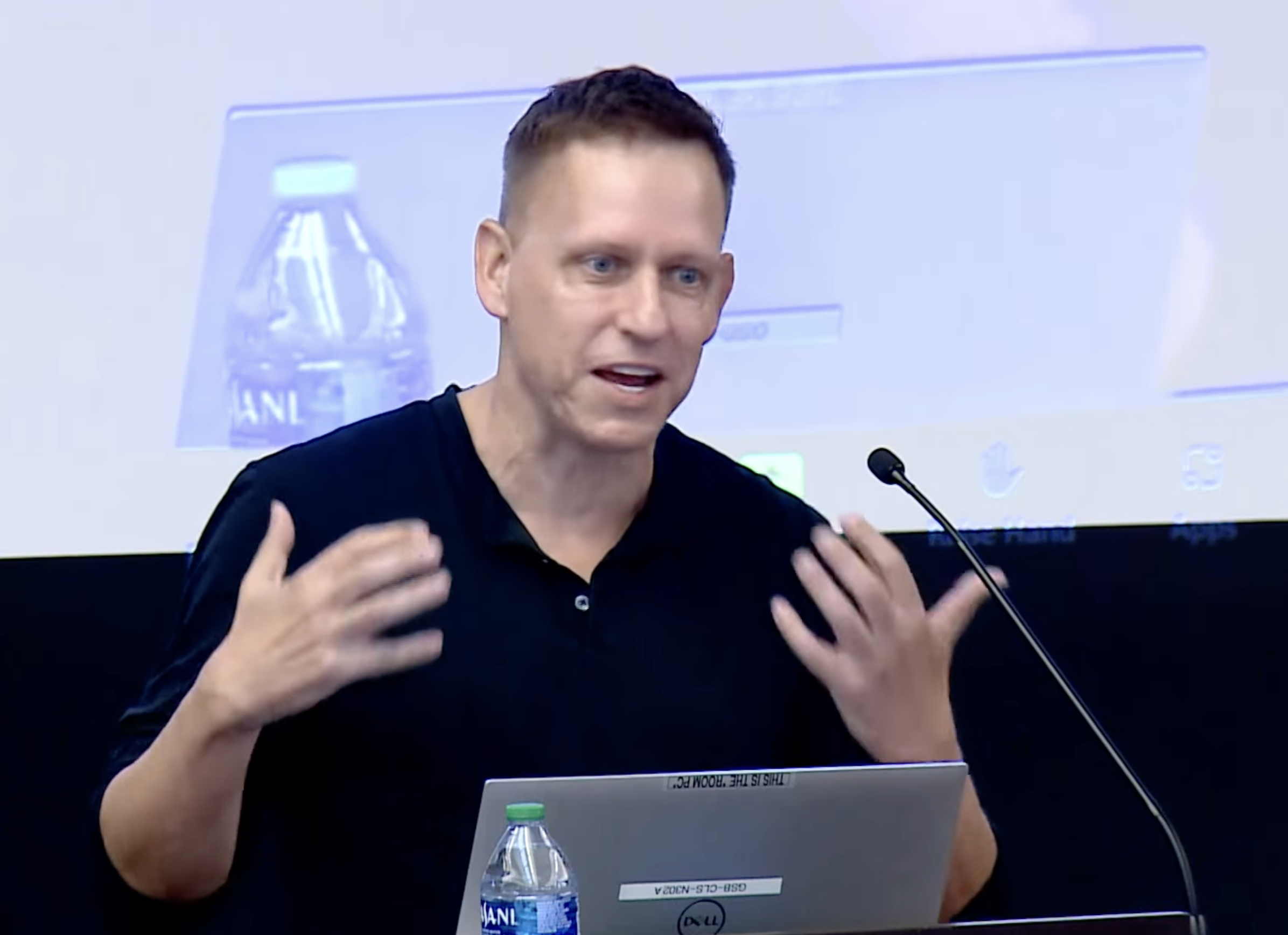
From PayPal to a Vertically Integrated Ideological Stack
Thiel and Musk first crossed paths in 2000, when Musk’s online financial-services company X.com merged with Thiel and Max Levchin’s Confinity to form what would shortly be renamed PayPal. The merger produced one of the most consequential alumni networks in American business — the so-called “PayPal Mafia” — and ended in a boardroom coup that pushed Musk out of the CEO seat and installed Thiel. eBay bought the company in 2002 for $1.5 billion. Musk netted roughly $176 million; Thiel about $55 million.
A quarter century later, both have built sprawling, vertically integrated empires that resemble each other more than they resemble traditional corporations.
Musk’s holdings — Tesla, SpaceX, Starlink, xAI, X (formerly Twitter), Neuralink, the Boring Company — are increasingly being consolidated under one roof. xAI was absorbed into SpaceX. X.com has as well. SpaceX is now preparing what analysts project will be the largest initial public offering in American history, with the company valued between $1.5 trillion and $2 trillion. Slobodian calls the result “a vertically integrated ideological stack” — one in which Musk can “build an echo chamber from low Earth orbit all the way back to Earth.”
Starlink Mobile, under development, would deliver direct-to-device internet across the planet. “At which point,” Slobodian said, “he’s able to kind of keep the legacy media — independent media sources — out of the conversation and produce a kind of hermetically closed loop.” In October 2025, xAI launched Grokipedia, an AI-generated encyclopedia Musk promoted as a Wikipedia alternative; researchers at Cornell and NBC News found it citing sources Wikipedia treats as unreliable, including the conspiracy site Infowars and the neo-Nazi forum Stormfront.
Thiel’s stack is structured differently but rhymes. His Founders Fund — nicknamed “the Precious” inside Thiel’s circle, after the One Ring — has positioned its portfolio as what The Economist describes as a trilogy of national-security plays: Palantir (data and surveillance, founded 2003), Anduril (defense hardware, founded 2017 by Thiel mentee Palmer Luckey), and General Matter (uranium enrichment, emerged from stealth in 2025). Thiel has named his companies and investment vehicles after Tolkien artifacts so insistently — Palantir, Mithril, Anduril, Rivendell — that the joke writes itself. The fund’s largest-ever check, $1 billion, went to Anduril in June 2025.
Palantir CEO Alex Karp would later put an explicit frame around the trilogy in his April 2026 manifesto: “The atomic age is ending. One age of deterrence, the atomic age, is ending, and a new era of deterrence built on A.I. is set to begin.” The fund’s three companies map almost exactly onto that succession.
In a recent interview with conservative commentator Ross Douthat for the New York Times, Thiel revisited his 2011 essay “The End of the Future,” in which he argued the world had entered a period of technological stagnation. “From 1750 to 1970 — 200-plus years — were periods of accelerating change,” Thiel said. “The ships were faster, the railroads were faster, the cars were faster, the planes were faster. It culminates in the Concorde and the Apollo missions, and then things slowed in all sorts of dimensions.” Crypto and AI are real breakthroughs, he allowed, “but I think broadly we’re in this world that’s still pretty stuck.”
The contradiction at the heart of both empires, Slobodian noted, is that they are deeply dependent on federal subsidies and government contracts — even as Musk personally led an effort to dismantle federal agencies. The book frames this not as hypocrisy but as a new model: “state symbiosis,” or what it calls “selling sovereignty as a service.”
State Symbiosis: From Trump 2016 to DOGE
Thiel made the move first. In 2016, he endorsed Donald Trump at the Republican National Convention, breaking with the Silicon Valley consensus and establishing what would become the template. He went on to bankroll the Senate campaigns of two former Thiel Capital employees: J.D. Vance, now vice president, and Blake Masters. Through the 1789 Capital fund — which Reuters reports Thiel was instrumental in creating — he helped build what its founders describe as a “parallel economy” of America First-aligned businesses, media outlets, and political organizations. Donald Trump Jr. joined as a partner in 2024.
Musk followed eight years later. He was the largest individual donor of the 2024 election, contributed $19 million to a single Wisconsin Supreme Court race in 2025, and from January 20 to May 28, 2025, served as Senior Advisor to the President and de facto head of the Department of Government Efficiency, or DOGE. A federal judge later ruled that Musk acted as DOGE’s de facto leader despite a White House sworn statement claiming he had “no actual or formal authority to make government decisions himself.” A Boston University model estimated that DOGE’s cuts to USAID resulted in roughly 400,000 child and 200,000 adult deaths by November 2025. At Trump’s second inauguration, Musk twice made a gesture widely interpreted in Germany — where such gestures are illegal — as a Nazi salute.
“You need to fuse with the state,” Slobodian said. “Someone like Peter Thiel pioneered this. Now, any vision that this is libertarian is not helpful. It’s a period of state symbiosis — selling sovereignty as a service.”
The Master Database
The most concrete fusion of the two men’s ideologies and federal power is unfolding inside Palantir.
The Trump administration has contracted with Palantir to build what reporting by McKenna Kelly in Wired describes as a “master database” designed to surveil and track immigrants across federal agencies. A $30 million contract with Immigration and Customs Enforcement gives Palantir “near real-time visibility into migrant movements” as ICE pursues a target of 3,000 arrests per day.
The architecture works by unifying siloed federal databases — IRS tax filings, Social Security Administration records, USCIS immigration files, voter rolls — through Palantir’s software platform, Foundry. DOGE leadership at the IRS orchestrated a “hackathon” aimed at creating a “mega-API” allowing privileged users to view all agency data from a single access point, which sources told Wired would likely be hosted on Palantir’s platform.
“If you have a Foundry system at IRS and one at DHS, those can talk to each other incredibly easily,” Kelly said. “You’re able to query a variety of data systems across government.”
IRS data is particularly valuable for immigration enforcement because it contains the most recent addresses for workers in the country — including immigrants who file taxes using ITIN numbers in lieu of Social Security numbers. Antonio Gracias, a Musk ally running operations at the Social Security Administration, acknowledged on a podcast that the agency cross-referenced SSA records against voter rolls to identify people who may have voted illegally.
The result is exactly the kind of cross-domain visibility that Slobodian’s “vertically integrated stack” predicts: data flowing in from one billionaire’s surveillance company, augmented in real time by the other billionaire’s social media megaphone, run through agencies whose staffing was reshaped by the same political project that put both at the center.
What checks govern this consolidation remains unclear. “At this point, we don’t really know for sure what the checks are,” Kelly said.
Where the Logic Lands: Memphis and the Manifesto
The gap between the utopian rhetoric and the ground reality is sharpest in two places: a Memphis neighborhood, and a 22-point manifesto.
The NAACP has sued Musk’s xAI, accusing it of violating the Clean Air Act by operating more than two dozen methane gas-burning turbines without legal permits at its Memphis data centers — known as Colossus and Colossus 2 — located adjacent to historically Black neighborhoods on the southwest side of the city.
“These turbines generate enough power to power over half a million homes,” said Keyshawn Pearson, executive director of Memphis Community Against Pollution. “This is unprecedented — the amount of pollution we’re being exposed to. Nitrogen dioxide, formaldehyde, chemicals we know cause cancer.”
Pearson said xAI’s pollution levels now exceed those of Memphis International Airport. Children in the surrounding area have the highest rate of emergency-room visits for respiratory illness in the state of Tennessee. Musk chose Memphis because he found an abandoned Electrolux factory he could repurpose quickly. “We needed a building. We can’t build a building,” Musk explained. The city’s mayor and the Greater Memphis Chamber welcomed the company with economic incentives.
“This is Elon Musk presenting an option for Memphis which we know is untrue,” Pearson said. “Southwest Memphis continues to be targeted. These projects specifically focus on a neighborhood where you see an increased poverty level and an increased amount of Black families.”
Pearson drew a direct line to history: “In 1968, Dr. Martin Luther King came and marched with sanitation workers in Memphis. That was fighting for environmental justice. And that is the fight we are continuing.”
In April 2026, Palantir CEO Alex Karp — Thiel’s longtime business partner — published a 22-point manifesto on social media, drawn from his book The Technological Republic, co-authored with Nicholas Zamiska. The document argues that Silicon Valley “owes a moral debt to the country that made its rise possible” and that “hard power in this century will be built on software.” It calls on engineers to participate in national defense, urges that “national service should be a universal duty,” and proposes moving away from the all-volunteer force so that the country will “only fight the next war if everyone shares in the risk and the cost.” It warns that AI weapons will be built regardless and that “our adversaries will not pause to indulge in theatrical debates.” It calls for re-arming Germany and Japan, condemns “the pervasive intolerance of religious belief in certain circles,” and includes the assertion: “Some cultures have produced vital advances; others remain dysfunctional and regressive” — adding that a pluralism without content risks asking, “inclusion into what?”
The manifesto also defends Musk by name. “The culture almost snickers at Musk’s interest in grand narrative,” Karp writes, “as if billionaires ought to simply stay in their lane of enriching themselves… Any curiosity or genuine interest in the value of what he has created is essentially dismissed, or perhaps lurks from beneath a thinly veiled scorn.” It is the clearest on-the-record signal that the two empires understand themselves as a single project — that Palantir’s chairman’s chosen CEO is willing to use Palantir’s own manifesto to vouch for the man running xAI, X, and SpaceX.
The two artifacts speak the same sentence in different registers. One says explicitly that some cultures are “dysfunctional and regressive.” The other quietly puts the methane turbines next to the Black neighborhood and not the white one.
“Palantir’s manifesto talks about cultural hierarchies,” Slobodian observed. “What Musk talks about day-to-day on X is the need for re-migration, the dangers of racialized immigration, the dangers of falling white birth rates.”
Apocalypse, Antichrist, and the Christian Frame
Surrounding the data systems and the data centers is a religious vocabulary that has steadily moved from the margin to the foreground.
In a recorded conversation on Stanford’s Uncommon Knowledge program, Thiel disclosed his preoccupation with Christian end-times prophecy — specifically, the figure of the Antichrist, which he described as “the final dictator of the one world state.” In a post-Christian era, Thiel argued, the category remains live and useful for understanding power. “If you think you’re more Christian than Christ, you’re in trouble,” he said — a warning he connected to ideologies that mimic Christianity while inverting its values. In a Stanford address, he framed his decades-long involvement in conservative culture wars as a defense of the Western canon against what he called a “post-modern multiversity” that is “nihilistic,” “relativistic,” and “in some parts totalitarian.” His provocation: “What is the antonym of diversity? University.”
Musk operates in a parallel idiom. He describes himself as a “cultural Christian,” a pronatalist who believes population decline is the greatest threat to civilization, and has repeatedly amplified the false claim of a “white genocide” in South Africa. In public remarks, he has described an AI-and-robotics future in which “things will just be free,” citing science-fiction author Iain Banks’s Culture series — a post-scarcity utopia — as a model. “If you’ve got an AI robotics economy that is anywhere close to a million times the size of the current Earth economy, literally any need you possibly want can be met.”
Slobodian was dismissive: “He’s free-associating what he hopes will be enough of a distraction that people won’t actually look at what his empire is being built on, and what he pushes out day-to-day on X — which has become a megaphone for a far-right international.” A February 2025 NBC News analysis found that Musk had boosted far-right political movements in at least 18 countries on six continents since 2023.
The Convergence
The two trajectories that began in southern Africa now run on Americans’ retirement savings. SpaceX, once Musk’s vehicle for Mars colonization, is projected to be fast-tracked into pension fund indexes — meaning that ordinary Americans’ pension and college retirement funds will be invested in an enterprise whose founder openly promotes what critics describe as an ethnonationalist worldview.
“People’s pension funds, college retirement funds — all of these things are now going to be part and parcel of often the quite vicious and xenophobic visions of the founder CEOs like Elon Musk,” Slobodian said.
The men themselves continue to converge. In January 2026, Musk made a last-minute World Economic Forum debut in Davos and then attended Dialog — the invitation-only gathering organized by Thiel and Auren Hoffman that some have dubbed “Tech Bilderberg.” Both men also surfaced in the Jeffrey Epstein files released by the House Oversight Committee in 2025 and 2026: Musk’s correspondence with Epstein from 2012 and 2013 was published in January 2026, and emails released in the 2026 batch revealed that Thiel’s Valar Ventures had accepted $40 million from Epstein and that Thiel had corresponded with Epstein for five years before his death.
Memphis Community Against Pollution is calling for a moratorium on new AI data center construction similar to one recently passed statewide in Maine. The NAACP lawsuit against xAI is being supported by the Southern Environmental Law Center and Earthjustice.
“In 1968, Dr. Martin Luther King came and marched with sanitation workers in Memphis,” Pearson said. “That was fighting for environmental justice. And that is the fight we are continuing.”
Sources: Democracy Now! interviews with Quinn Slobodian (Boston University), Chris McGreal (The Guardian), and Keyshawn Pearson (Memphis Community Against Pollution); Wired reporting by McKenna Kelly; Palantir Technologies Twitter manifesto, April 18, 2026; Peter Thiel interviews on Uncommon Knowledge (Hoover Institution) and Interesting Times (New York Times); Slobodian and Tarnoff, Muskism: A Guide for the Perplexed; Wikipedia entries on Elon Musk and Peter Thiel.