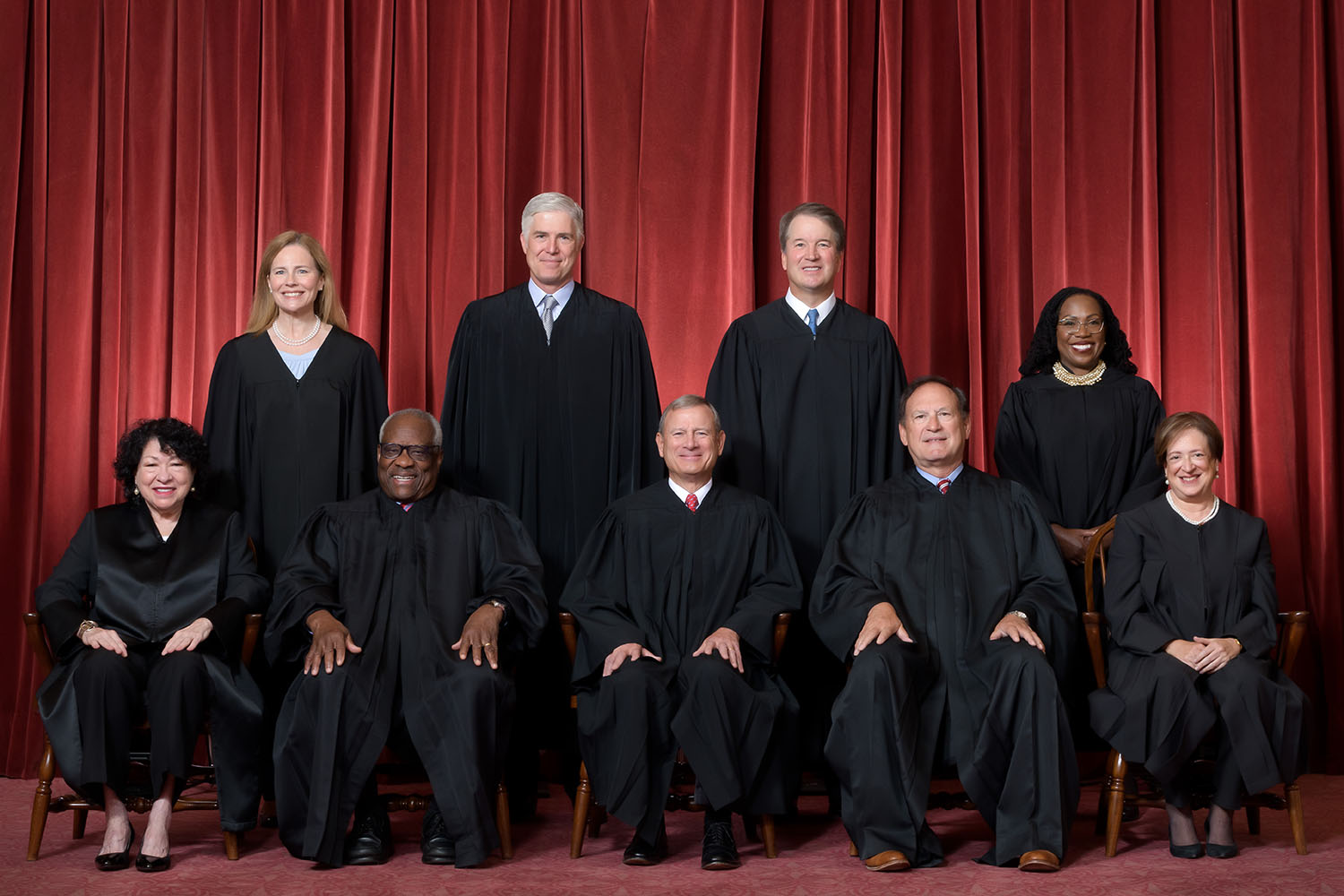
The Supreme Court on April 29th struck down Louisiana’s congressional map as an unconstitutional racial gerrymander and rewrote the 40-year-old framework that has governed the Voting Rights Act, in a 6-3 decision that the three dissenting justices said effectively guts what is left of the law.
Justice Samuel Alito, writing for the Court in Louisiana v. Callais, held that compliance with Section 2 of the Voting Rights Act did not require the State to draw a second majority-Black district, and that its decision to do so triggered strict scrutiny that the State could not survive. Along the way, the majority “updated” the test laid out in Thornburg v. Gingles in 1986 and applied for four decades since.
Justice Elena Kagan, joined by Justices Sonia Sotomayor and Ketanji Brown Jackson, wrote a 48-page dissent calling the ruling the final step in a long campaign against the Voting Rights Act. “I dissent, then, from this latest chapter in the majority’s now-completed demolition of the Voting Rights Act,” she wrote.
The Cracked Circle
Kagan opened her opinion with a stylized hypothetical that she said “in its essence simulates the dispute before us.” Imagine a State, she wrote, with a long history of racial discrimination and continuing residential segregation. In the middle sits a single circular district that is 90% Black; five surrounding districts are each 90% White. Voting is racially polarized along party lines.
Then the legislature slices the circle into six pie pieces and folds each into a surrounding majority-White district. Black voters can still cast ballots, “but given the State’s racially polarized voting, they cannot hope — in the way the State’s White citizens can — to elect a person whom they think will well represent their interests.”
“That is racial vote dilution in its most classic form,” Kagan wrote. Under Section 2 as Congress amended it in 1982, she argued, that scheme would be illegal — a districting plan that, in the totality of circumstances, “results in” minority voters having “less opportunity” than others to elect representatives of their choice.
“But no longer,” she wrote. “Under the Court’s new view of Section 2, a State can, without legal consequence, systematically dilute minority citizens’ voting power.”
The Callais Requirements
The majority described its work as a few “technical tweaks” to the Gingles framework. Kagan rejected the label and gave the new test her own name: “the Callais requirements.” She identified three changes, each of which, she argued, drives plaintiffs toward proving discriminatory motive — exactly what Congress had said was not required.
Illustrative maps must match the State’s political goals. Under Gingles, plaintiffs alleging vote dilution have long had to show that a reasonably configured majority-minority district could be drawn. Now, Kagan wrote, those alternative maps must also satisfy every political goal the State asserts, “including ‘partisan distribution’ of districts” and the partisan balance within them. Where race and party are correlated — almost everywhere Section 2 still operates — plaintiffs cannot draw a map that simultaneously protects the State’s preferred partisan outcome and creates a majority-minority district. “States now have an automatic political-gerrymandering defense to vote-dilution claims,” she wrote.
Racially polarized voting must be proven net of party. The second and third Gingles preconditions ask whether minority and majority voters cohesively support different candidates. The new rule, Kagan wrote, requires plaintiffs to “remove from the equation … polarized voting preferences” by controlling for partisan affiliation. “For in most places,” she wrote, “partisan difference is the way those divergent preferences are expressed.”
The totality-of-circumstances test is reduced to present-day intent. Kagan wrote that the majority flattens the inquiry into a search for “intentional present-day voting discrimination,” cutting out the broader social, historical, and political context that White v. Regester and Gingles directed courts to weigh.
The combined effect, she wrote, is to revert Section 2 to the regime the Court adopted in Mobile v. Bolden in 1980 — the very ruling Congress overrode two years later. “It is Bolden redux.”
When the dissent turned to the Louisiana facts, Kagan was caustic. The District Court had heard five days of testimony and produced a 110-page opinion finding likely vote dilution. The majority, she wrote, dispatched it in a few paragraphs: failed first precondition, failed second and third, failed totality. “Bang, bang, bang. It is like shooting fish in a barrel.”
A Trilogy of Demolition
Kagan placed the decision as the last of three blows to the Voting Rights Act. In Shelby County v. Holder (2013), the Court suspended Section 5 preclearance, the mechanism that had required jurisdictions with a history of suppression to clear new voting rules with the Justice Department. In Brnovich v. Democratic National Committee (2021), the Court invented a standard that, by Kagan’s count and that of election-law scholars, has yet to allow a single Section 2 challenge to a vote-suppressing rule to succeed. With Callais, she wrote, “the last piece — Section 2 as applied to redistricting” falls.
The Voting Rights Act, she wrote, “is — or, now more accurately, was — ‘one of the most consequential, efficacious, and amply justified exercises of federal legislative power in our Nation’s history.’” She invoked Justice Ruth Bader Ginsburg’s Shelby County dissent, including the line that the Court’s reasoning was “like throwing away your umbrella in a rainstorm because you are not getting wet.”
“It was born of the literal blood of Union soldiers and civil rights marchers,” Kagan wrote of the Act.
A Stare Decisis Problem
Three Terms ago, in Allen v. Milligan, the Court rejected Alabama’s invitation to remake the Gingles framework, citing what Kagan called “superpowered” statutory stare decisis. Justice Alito dissented in Allen in terms that, Kagan wrote, “prefigured today’s opinion.”
“Nothing has changed in the three years since,” she wrote of the Court’s reversal. The majority opinion, she noted, does not mention stare decisis. She invited readers to do their own audit: “Just search for every quotation from Allen in this opinion … and ask yourself whether it is credible that Allen ‘did not address’ the question of ‘our understanding of §2 as Gingles construed it.’ … Better yet, go read all of Allen.”
What Comes Next
Kagan warned that the consequences will reach well beyond the Louisiana district struck down. The State’s other majority-Black district — District 2, drawn after a 1983 vote-dilution suit — is, on her reading of the new rules, equally vulnerable. A legislature that announces an all-Republican congressional delegation as its political goal will, under Callais, have a near-complete defense against any claim that cracking the district dilutes Black votes.
“The Callais requirements have thus laid the groundwork for the largest reduction in minority representation since the era following Reconstruction,” she wrote. “After today, those districts exist only on sufferance, and probably not for long.”
She closed by returning to a line from Justice Thurgood Marshall’s Bolden dissent: that without an effects test, the right to vote becomes for minority citizens “nothing more than the right to cast meaningless ballots.”
“I dissent because Congress elected otherwise,” Kagan wrote. “I dissent because the Court betrays its duty to faithfully implement the great statute Congress wrote. I dissent because the Court’s decision will set back the foundational right Congress granted of racial equality in electoral opportunity. I dissent.”