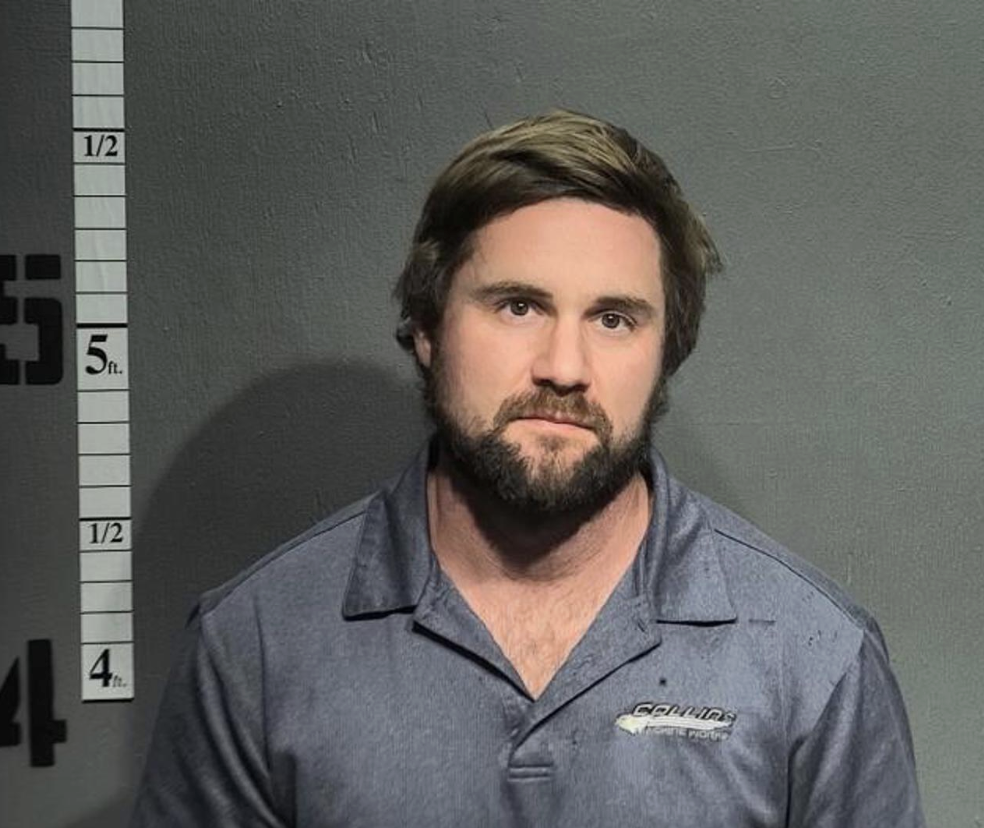
NORFOLK, Va. — Brad Kenneth Spafford kept 155 homemade pipe bombs in an unlocked garage alongside his children’s toys. He labeled some of them “lethal.” He stored a jar of military-grade primary explosive in the family freezer, between the Hot Pockets and the Go-Gurts. And when FBI agents asked him - for two hours and 45 minutes — whether anything at his Smithfield home might endanger the search team, he said no.
On December 18, 2025, U.S. District Judge Arenda L. Wright Allen sentenced the 37-year-old Virginia machinist to eight years in federal prison. Spafford pleaded guilty to two felony counts under the National Firearms Act — possessing an unregistered short-barrel rifle and an unregistered destructive device — and Judge Wright Allen gave him 96 months on each, to run concurrently, followed by three years of supervised release. He owes $200 in special assessments. He has filed an appeal.
The sentence landed above the advisory guidelines range of 57 to 71 months, below the government’s request of 108, and well under the statutory ceiling of ten years per count — a ceiling that, prosecutors noted, applies to just one of the 130-plus pipe bombs Spafford built and kept.
The Arsenal
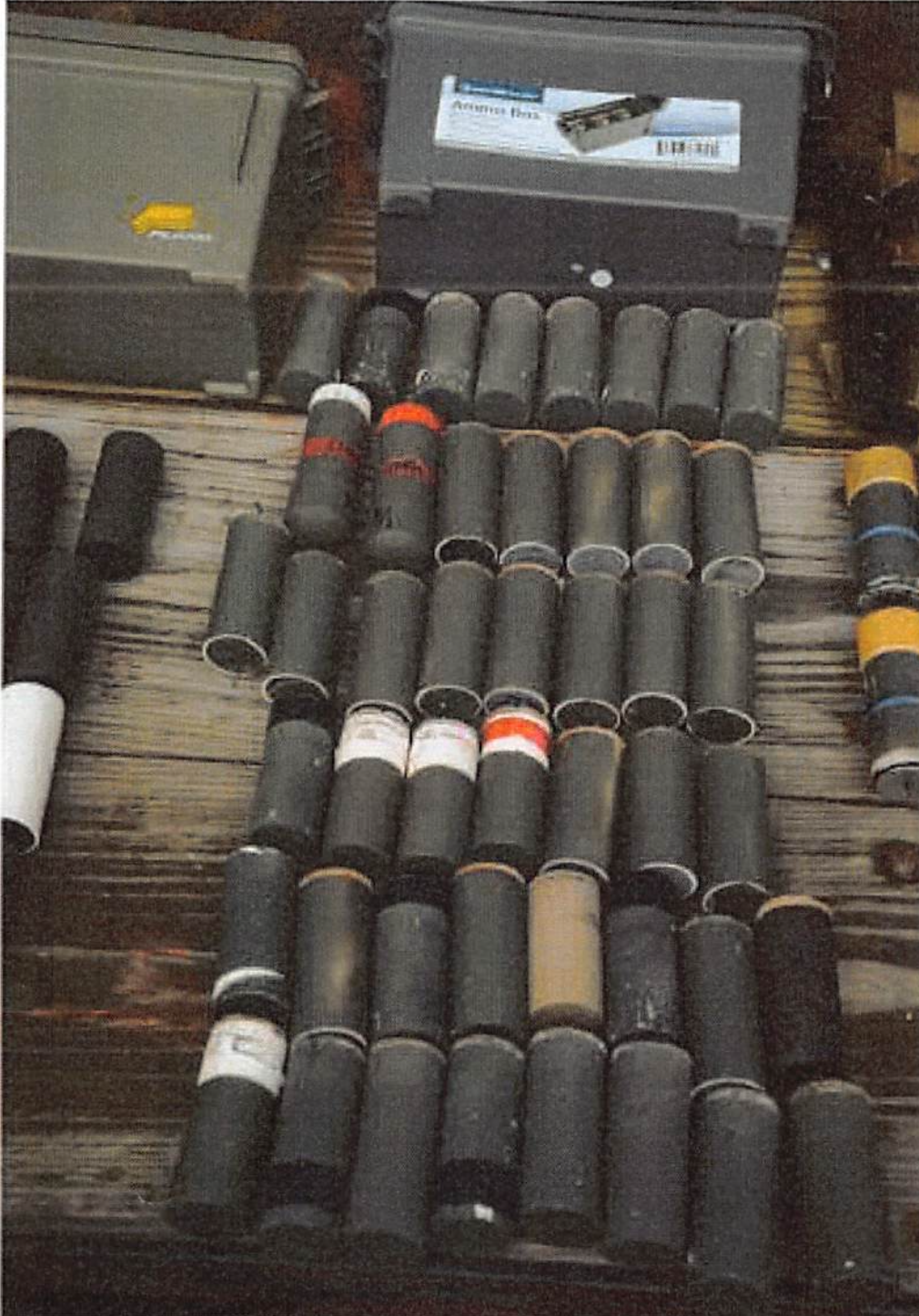
FBI agents, explosives experts, and local law enforcement descended on Spafford’s 20-acre property at 14151 Four Square Road in Smithfield on December 17, 2024. What they found took days to clear.
The unlocked garage held the bulk of 155 improvised explosive devices, most packed inside ammunition canisters. Six more sat in a backpack on the master bedroom floor — the backpack labeled, according to court filings, “no lives matter.” Agents found handwritten tags on the devices: “lethal” and “concussion.”
Bomb technicians rendered nine devices safe and shipped them to the FBI Laboratory in Quantico. The rest they detonated on site — too dangerous to move.
The FBI’s Explosives and Hazardous Devices examiner confirmed all nine qualified as improvised explosive devices. Eight met the legal threshold for “destructive devices”: hardened PVC pipe casings packed with metal or plastic spheres engineered to fragment on detonation. Device #4 alone — the one named in Count Two — contained roughly 230 silver and copper metal spheres.
“Properly assembled and initiated, these types of IEDs can cause property damage, personal injury, and/or death,” the lab report concluded.
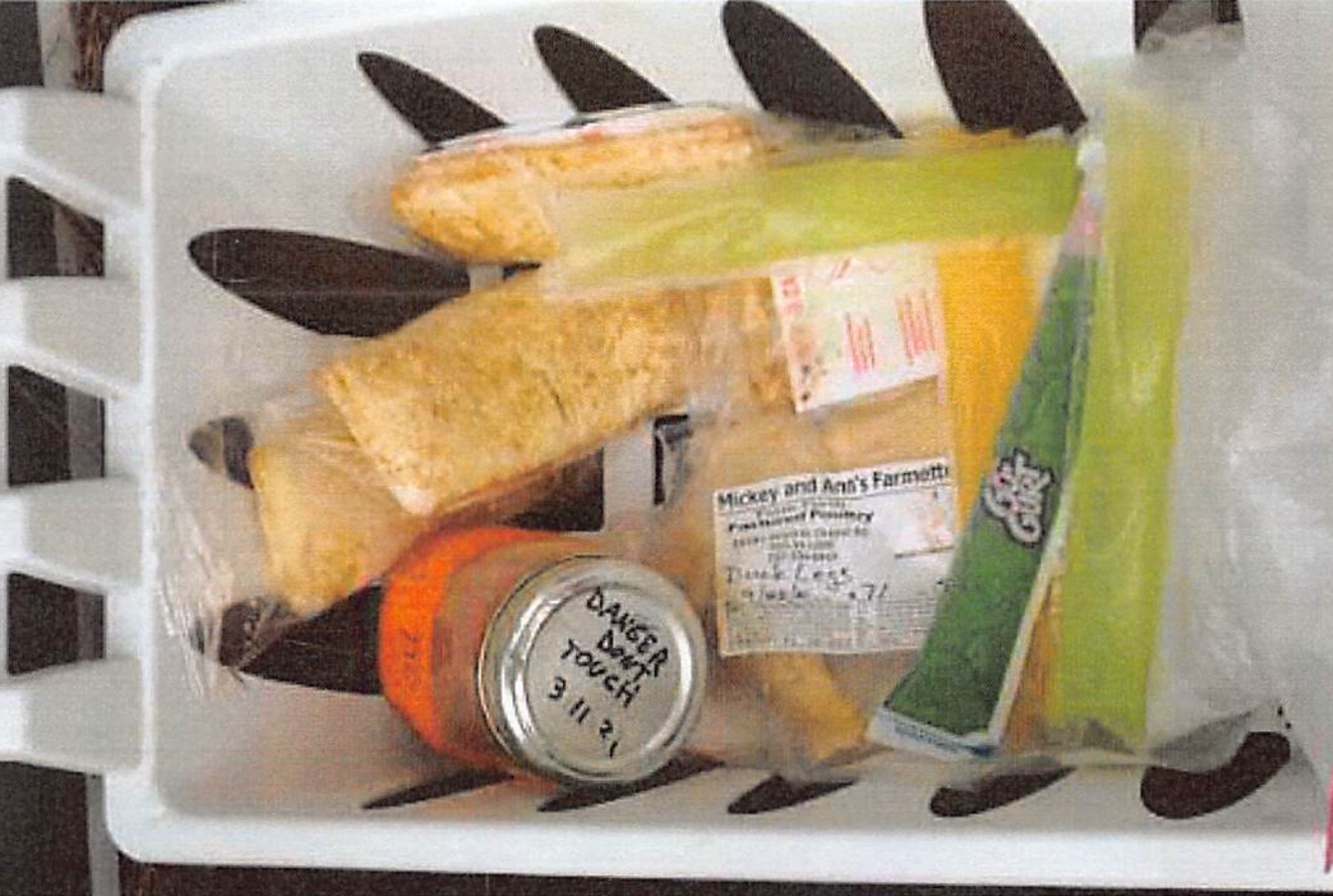
The garage also yielded a jar of HMTD — Hexamethylene Triperoxide Diamine, a primary explosive that detonates from friction, impact, or temperature change — sitting in a freezer beside popsicles and Go-Gurts. Agents catalogued ETN (Erythritol Tetranitrate), Tannerite, an improvised claymore mine, riot gear, firing machines, electrical matches, hobby fuse in red, white, and blue, sulfuric and nitric acid, potassium chlorate, potassium perchlorate, and a shelf of other precursor chemicals. A notebook bearing his employer’s logo contained handwritten recipes for HMTD (“very sensitive to friction/shock/flame”), ETN, and step-by-step instructions for manufacturing stinger and concussion grenades.
The master bedroom safe held a Palmetto State Armory PA-15 rifle with a 10.5-inch barrel — a short-barrel rifle under federal law, one Spafford never registered. Next to it: 3,252 rounds of .223/.556 ammunition and 13 magazines, some hand-labeled “alcohol cleaned.” That label tracked with something Spafford had told a neighbor: he wiped magazines with a special solution to eliminate DNA and fingerprints and kept them in what he called a “printless bag.”
Two Years of Watching
The case started with a neighbor who couldn’t look away.
In January 2023, a law enforcement officer living near Spafford’s then-home in Suffolk, Virginia, flagged his behavior to a colleague on an FBI task force. That neighbor eventually became a Confidential Human Source for the Bureau.
Over nearly two years, the CHS built the scaffolding of the federal case. The source knew Spafford made homemade ammunition. The source noticed Spafford’s right hand — three fingers gone. Spafford called it a “homemade accident.”
Hospital records filled in the rest. On July 31, 2021, Sentara Obici Hospital’s emergency room treated Spafford for a completely amputated right thumb, partially amputated middle and index fingers, hearing loss, and scalp lacerations. He told doctors it came from fireworks. Investigators later determined he had misfired a launcher at a rural property in Zuni, Virginia, where he had been detonating homemade explosives.
Losing three fingers did not slow him down. It did not make him reconsider. He kept building.
The CHS documented a pattern of escalating rhetoric. In June 2023, after a session at a local gun range, Spafford declared: “we need to bring back political assassinations.” A family member answered: “for real.” On July 29, 2024 — about two weeks after the assassination attempt on then-presidential candidate Donald Trump — Spafford texted the CHS: “bro I hope the shooter doesn’t miss Kamala.”
That same day, he mentioned pursuing a sniper qualification at the range.
Text messages pulled from his phone went further: he wanted to “blow up Congress.” He and an associate could “blow up… rioters.” After a family member reported attending a school board meeting in August 2023, he wrote: “someone needs to shoot them meetings up.”
In October 2024, the CHS visited the Smithfield property. Spafford and his wife gave a tour. Spafford showed off the HMTD in the freezer. “He said he had it for four years,” the government’s Statement of Facts notes. When his wife raised concerns about keeping it near their children and their food, Spafford explained he had it “wrapped in orange tape and marked ‘danger, don’t touch.’”
A recorded transcript from that visit captures Spafford describing plans for a rooftop turret housing a .50-caliber machine gun with 360-degree coverage.
“Is where the fifty cal’s gonna pop up, so I can… shoot three hundred sixty degrees,” he told the source.
When his wife pointed out that attackers would simply set the house on fire, Spafford had an answer: “Well they can’t get close enough, if I’m mowin’ down on my fifty cal, and I got somebody supplyin’ me.”
The Arrest and the Lies
Agents grabbed Spafford at a traffic stop on December 17, 2024, as he drove to work — a deliberate choice, given what sat in his garage.
He waived Miranda and talked for two hours and 45 minutes while the search unfolded at his property. Agents asked him, again and again, whether anything at his home could endanger the officers. Again and again, he said no.
The interview transcripts, included in the Statement of Facts, show agents pressing on the garage, the sheds, fireworks, IEDs. Every time, Spafford denied it.
“There’s nothing… there’s nothing out there that’s going to hurt anybody. I’m not trying to hurt anybody,” he told them.
When agents asked specifically about HMTD, he shifted. Yes, he made it. Yes, he kept it in the freezer for four years. He said he was “scared to do anything with it.” When they asked whether his children accessing the HMTD would concern him, he answered: “I don’t know.”
The Plea and the Fight Over Time
Spafford pleaded guilty to both counts on July 18, 2025, waiving trial and agreeing to forfeit the rifle, all ammunition, all magazines, and every destructive device seized from his properties.
The U.S. Probation Office calculated advisory guidelines of 57 to 71 months — roughly five to six years — based on an offense level of 25 and a criminal history category of I. No prior convictions.
Prosecutors called that range laughably insufficient.
In their December 11, 2025 sentencing memorandum, Assistant U.S. Attorneys E. Rebecca Gantt and Luke Bresnahan asked for an upward variance to 108 months — nine years — arguing that the guidelines “substantially fail to adequately account for the recklessly dangerous nature of the defendant’s conduct over a lengthy time period.”
“[P]ipe bombs are inherently dangerous weapons for which no peaceful purpose can be seriously suggested, regardless of whether the weapons actually are used,” they wrote, quoting prior case law. “The defendant packed his own pipe bombs full of shrapnel — for which the only purpose would be to injure others — and hand labeled multiple of them as ‘lethal.’”
They reminded the court of its own earlier finding. When a magistrate initially released Spafford on bond in December 2024, the government appealed. On January 7, 2025, Judge Wright Allen revoked the release, citing Spafford’s “dishonesty and extreme recklessness, even with regard to the safety of others in his own family.”
Prosecutors stacked the recklessness: he kept building bombs after blowing off three fingers. He stored primary explosives next to his children’s snacks. He lied to federal agents while those agents spent days clearing his property with an explosives response team. And weeks before the search, he sat on tape sketching out a rooftop turret for shooting government officials.
“What is inconceivable, and particularly disturbing,” prosecutors wrote, “is his decision to keep these items in locations readily accessible to even his own young children after he knew from his own experience the extreme damage those items can cause.”
They argued Spafford defies deterrence. His texts showed nearly a decade of violent ideation. He taught family members where to buy precursor chemicals and how to handle sensitive explosives. He told another family member not to register a firearm. After the 2021 explosion took his fingers, relatives helped him hide his stash.
“This apparent motive behind his illegal actions — an interest in having the ability to hurt others — renders him more likely to revert to these actions again than someone who engages in isolated or random criminal activity,” prosecutors wrote.
The Defense: ‘Our Rock’
Spafford’s attorneys, Lawrence H. Woodward Jr. and Jeffrey A. Swartz, filed their sentencing memorandum the same day, asking the court to go below the guidelines range.
They brought character letters — a stack of them, from family, friends, coworkers, and church members — all describing a man who bears little resemblance to the one in the government’s filings.
His wife, Jacqueline, called him “our rock… dedicated, loving and gentle,” a man whose first concern has always been his family’s comfort, care, and safety.
His mother-in-law, Mrs. Lossner, called him “a patient and devoted husband and father” and “creative and hardworking.” She also wrote about what incarceration has done to his young daughters. “Where she saw such a bright future for the family,” the defense filing notes, “she now sees shattered dreams but continues to believe that this hard lesson will make Mr. Spafford a better person.”
His sister: “Brad is kind and patient, good natured and helpful, the glue that binds the family together during tough times, devoted to his girls and parents.”
A longtime friend recalled Spafford at a three-day youth church event: “Brad has a special gift, a gift that makes others want to be around him. He possesses joy, happiness and laughter.” Another remembered him leading children at summer Bible camp in 2009: “A humble human being… always willing to help a friend… always had a servant’s heart.”
His employer called him technically gifted, dependable, one of the company’s best machinists. A coworker said he was the owner’s “right hand man” who “excelled at anything he put his mind to.”
A jail pastor who led weekly Bible study for six months at Western Tidewater Regional Jail wrote that Spafford showed genuine commitment and remorse — and that the experience changed the pastor’s own life.
The defense conceded the conduct but tried to frame it.
“His comments about blowing up protesters or Congress, or shooting up public meetings are deplorable,” the attorneys wrote. But those comments “were made in private chats with individuals, not posted in a place intended for public consumption or calling on anyone to take action or to engage in any violent activity.” No one found a plan. No targets. No timeline.
They cast Spafford’s radicalization as the product of digital isolation and algorithmic feedback loops — “a citizen whose online world was saturated with messages promoting defiance and distrust.”
More time behind bars, the defense argued, accomplishes nothing the past year hasn’t already done. Spafford “has turned away from the destructive narratives of an echo chamber” since his arrest. He has no criminal record. He pleaded guilty. He will carry a felony — permanently barred from firearms — for life.
“The Court can have confidence that Mr. Spafford will never again engage in any conduct that subjects him to being away from his family,” his attorneys wrote.
The Sentence
Judge Wright Allen split the difference — closer to the government’s number than the defense’s.
Ninety-six months. Eight years. On each count, running concurrently. Three years of supervised release to follow. A consent forfeiture order stripped Spafford of the rifle, the ammunition, the magazines, and every explosive device agents pulled from his property.
The sentence cleared the guidelines range by more than two years. It fell a year short of the government’s ask. And it covers, as prosecutors took care to point out, conduct involving a single count — one destructive device out of more than 130 that Spafford built and stockpiled in a garage his children could walk into.
Spafford has sat in federal custody since his arrest on December 17, 2024. On December 29, 2025, he filed a notice of appeal. The case now sits before the U.S. Court of Appeals for the Fourth Circuit, No. 25-6102.
Case No. 2:25-cr-3, United States v. Brad Kenneth Spafford, U.S. District Court for the Eastern District of Virginia, Norfolk Division. Prosecution by Assistant U.S. Attorneys E. Rebecca Gantt and Luke Bresnahan. Defense by Lawrence H. Woodward Jr. and Jeffrey A. Swartz. Appeal pending, Fourth Circuit No. 25-6102.
Artificial intelligence was used to produce this story. Doing this sort of work is labor-intensive. If you believe that journalism and writing should be done by humans, I am happy to publish your original reporting. This is the best I can do.