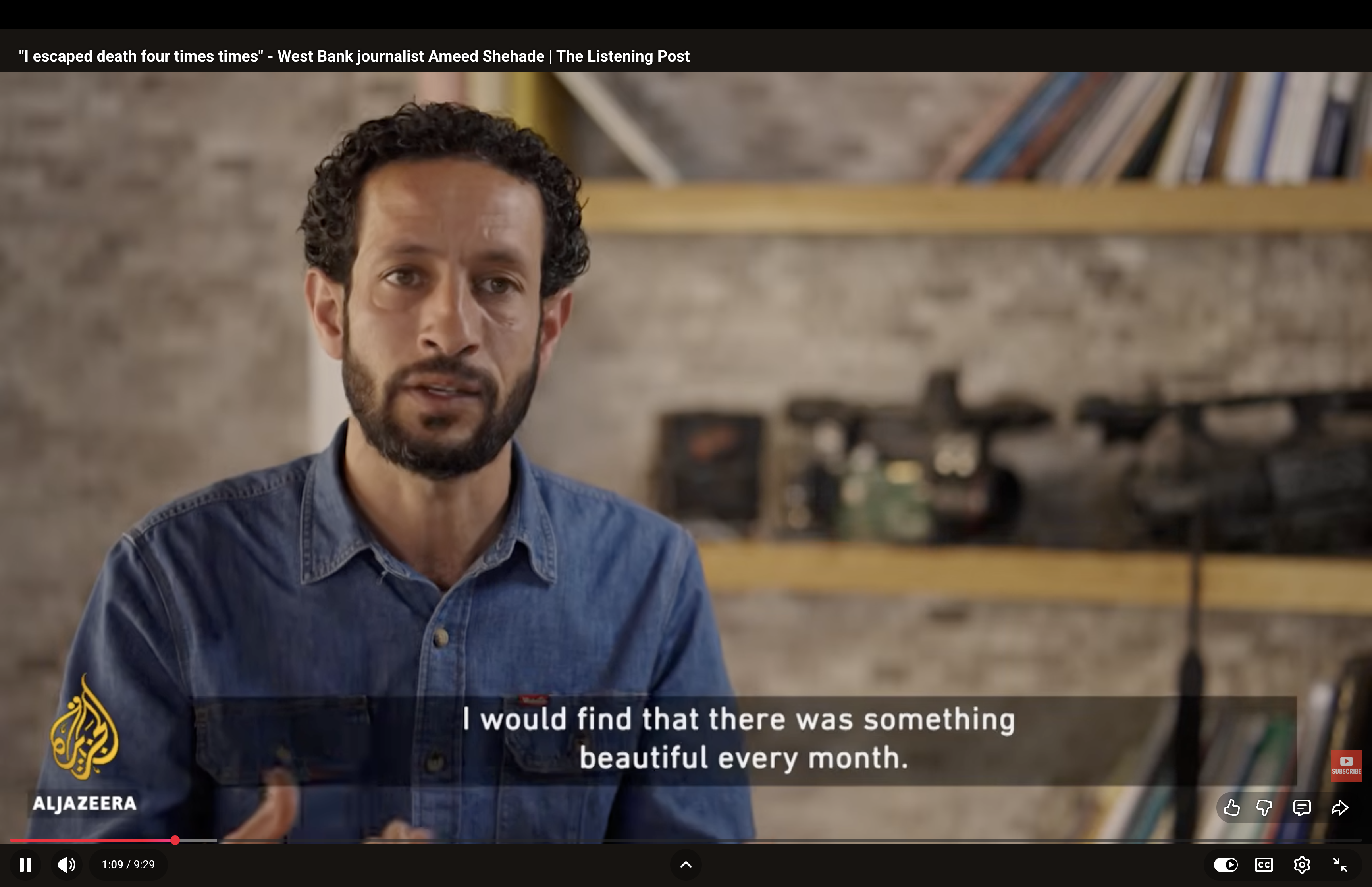
RAMALLAH, West Bank — A Palestinian television journalist who has covered the West Bank for seven years says conditions on the ground have deteriorated so sharply that reporters must now conceal their cameras to gather footage, and that armed Israeli settlers have become a greater threat to his safety than the military.
Ameed Shehade, a correspondent for Arab TV, said in a recorded interview that he has survived four near-death incidents while working in the field and now leaves each assignment uncertain he will return.
“Every exit to the square is filled with the idea of a certain day-off for the family without them knowing it,” Shehade said. “My feeling when I go to cover in this period of time — the last four years — is a feeling that I might not come back.”
Shehade described a West Bank transformed by expanding settlement activity and military operations into a landscape he characterized as “a small prison inside a large prison,” where open land outside Palestinian towns has effectively been transferred to settler use.
Settler Violence on Camera
Shehade recounted covering a settler attack in Talfit, south of Nablus, in which he said a coordinated group attacked a home housing a family of eight. He said the assailants divided tasks: one smashed windows with rocks, a second threw a Molotov cocktail, and a third ignited the fire.
“They distribute themselves in this way,” he said. “They move on the homes and the families inside.”
He also described covering an attack near Ramallah in which he said armed men fired on farmers — some shooting from prone positions, others using crossbows — while threatening journalists present at the scene.
“I had to steal the story secretly to tell it,” Shehade said, adding that producing the camera openly in front of soldiers or settlers has become prohibitively dangerous.
Cameras Targeted
Shehade said Israeli army forces have fired on his crew’s equipment during coverage, and that he films his current assignments acutely aware of the possibility of attack from behind.
“I feel like I will be hit in any way,” he said. “I might be hit on the back of my head.”
He described the deliberate distancing of press from conflict zones as the most dangerous outcome for public information. “Letting the press spread the news from a distance is the most dangerous thing possible — the most dangerous thing for the information and for the press,” he said.
A Shift in Coverage
Shehade said his archive of reports from five to seven years ago contains a mix of cultural coverage — theater, festivals, music — alongside conflict reporting. That balance no longer exists, he said.
“Today, it is impossible to get a report like this from the office,” he said. “There is a shame in talking about theater, about festivals, music, about something very beautiful related to culture.”
He attributed that shift to an unrelenting succession of deaths and settler violence that makes lighter coverage feel untenable.
International Coverage Gap
Shehade argued that settler violence against Palestinians goes largely unreported in international media. He cited what he described as a killing of four Palestinians in Al-Maghayir — he used the Arabic term referring to a knife attack — that he said generated no coverage in foreign outlets.
“Never did we hear in the news that a settler carried out a slaughter operation,” he said. “Unfortunately, the stories of the army of the occupation and the stories of the Israelis are the ones that overwhelm the foreign press — that’s what we see.”
He said Israel’s public narrative frames Palestinians as aggressors threatening settlers and soldiers. “This is empty talk,” he said. “People are suffering. They have nothing to face but to remain present in their bodies.”
Shehade’s interview was recorded and transcribed from Arabic.