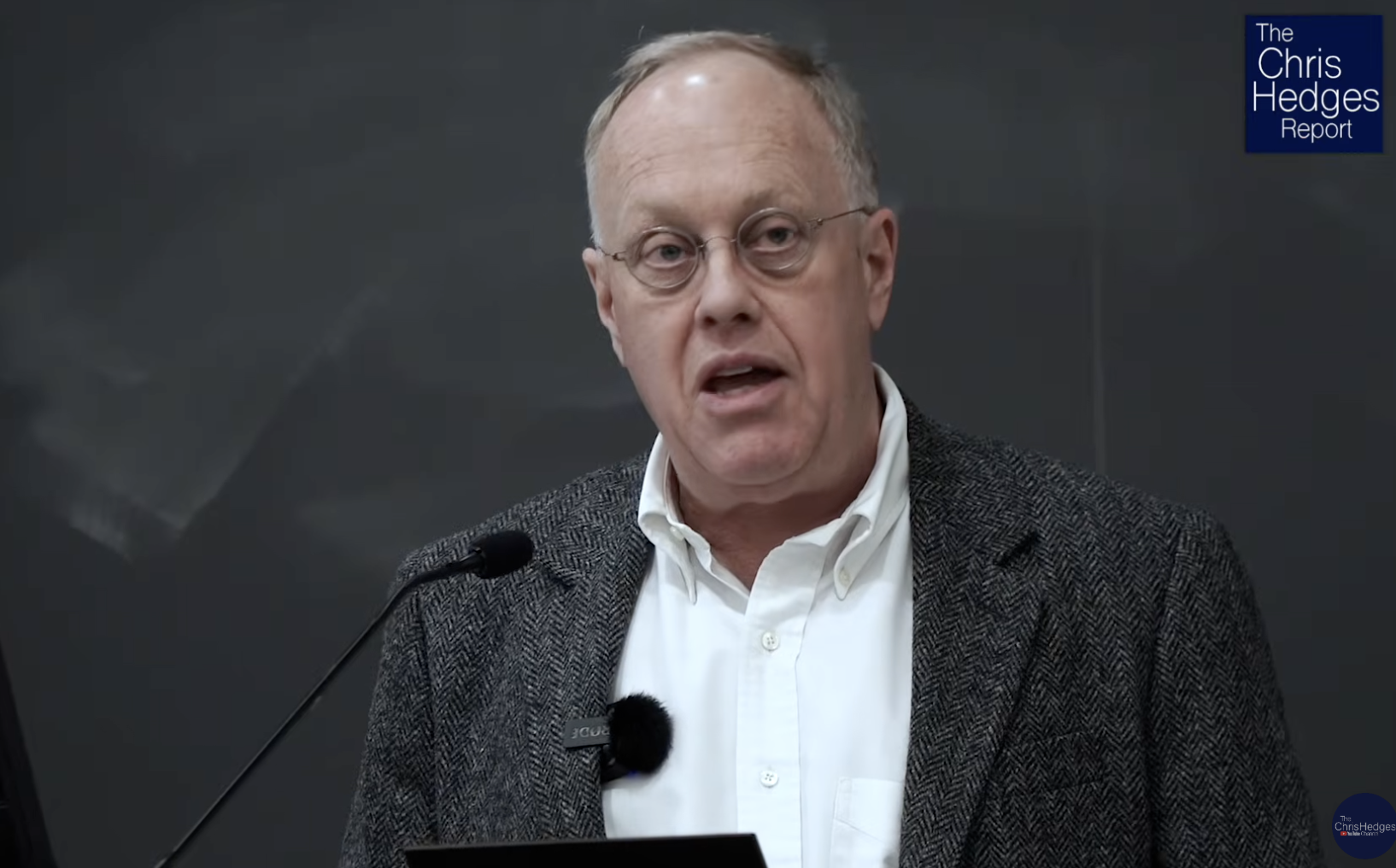
PRINCETON, N.J. — Journalist and author Chris Hedges told an audience at Princeton University that the ongoing conflicts in Gaza, Lebanon, and Iran represent the opening of a new era of unchecked state violence, arguing that international law is dead and that the same forces carrying out mass killing abroad are dismantling democratic institutions at home.
“The genocide in Gaza is the beginning,” Hedges said. “Welcome to the new world order, the age of technologically advanced barbarism. There are no rules for the strong, only for the weak.”
Hedges, who spent seven years reporting from Israel and Palestine for the New York Times and has covered the region for decades, spoke as U.S. military operations against Iran continued following what he described as the start of the war on February 28th. He said more than six million people have been rendered homeless across the three conflict zones — two million in Gaza, one million in Lebanon representing one-fifth of that country’s population, and three million in Iran.
Iran War Driven by Israeli Pressure, Former U.S. Official Said
Hedges cited the resignation letter of Joseph Kent, who stepped down as director of the National Counterterrorism Center to protest the war on Iran. Kent wrote that “Iran posed no imminent threat to our nation” and that “we started this war due to pressure from Israel and its powerful American lobby.”
Hedges said previous administrations of both parties had refused Israeli Prime Minister Benjamin Netanyahu’s four-decade lobbying effort to draw the United States into war with Iran, in part due to opposition from the Pentagon, which “did not view Iran as an existential threat and did not project a positive outcome.” He said the Trump administration, advised by Jared Kushner and Steve Witkoff, whom Hedges described as “fervent Zionists,” reversed that position.
The stated rationale for the war, Hedges said, “has been protean” — shifting among targeting Iran’s nuclear program, its ballistic missile program, human rights concerns, and regime change.
Israel Seeks Iran’s Disintegration, Hedges Argued
Beyond regime change, Hedges contended that Israel seeks the physical breakup of Iran into warring ethnic and religious factions — a pattern he said it pursued in Iraq, Syria, Libya, and Lebanon. Persians constitute roughly 61 percent of Iran’s population, with Azerbaijanis, Kurds, Baluch, Arabs, Turkmens, and various religious minorities making up the remainder.
“The shattering of Iran into antagonistic ethnic and religious enclaves would leave Israel the dominant power in the region,” he said, adding that a failed Iranian state would also open access to the country’s natural gas reserves, the second largest in the world, and oil reserves representing 12 percent of the global total.
Holocaust Scholarship Accused of Serving Political Ends
Hedges devoted a substantial portion of the address to a critique of Holocaust institutions and scholars, whom he accused of selectively applying the lessons of the Nazi genocide to shield Israel from accountability.
“Nearly all Holocaust scholars have refused to condemn the genocide in Gaza,” he said. “Not one of the institutions dedicated to researching and commemorating the Holocaust have drawn the obvious historical parallels or decried the mass slaughter.”
He cited the Holocaust Museum in Los Angeles, which deleted an Instagram post reading “Never again can’t only mean never again for Jews” following backlash.
He drew on the work of Primo Levi, the Auschwitz survivor and author, who criticized the use of Jewish victimhood to confer blanket moral authority. Levi, Hedges noted, was a fierce critic of the Israeli state and was considered persona non grata there.
Hedges also cited Israeli historian and genocide scholar Raz Segal, director of the Holocaust and Genocide Studies program at Stockton University in New Jersey, who published an article in October 2023 titled “A Textbook Case of Genocide.” Segal’s pending appointment to lead the University of Minnesota’s Center for Holocaust and Genocide Studies was subsequently revoked.
“The whole idea about prevention and never again is that there are red flags that once we notice them we’re supposed to work to stop the process that could escalate to genocide,” Hedges quoted Segal as saying, “even if it’s not genocidal yet.”
Dissent Being Silenced, Hedges Said
Hedges accused the press and political leadership of masking or excusing the violence. He said the New York Times issued an internal memo directing reporters and editors to avoid the terms “refugee camps,” “occupied territory,” “ethnic cleansing,” and “genocide” when writing about Gaza.
He said students who organized protest encampments at Princeton and other campuses are “smeared, blacklisted, and purged” and face arrest and deportation. He warned that FCC Chair Brendan Carr has proposed revoking broadcasting licenses for outlets that oppose the war on Iran.
“Those who name and denounce this evil are silenced,” he said. “A deadening silence is descending upon us, the silence of all authoritarian states.”
Hedges closed by connecting the foreign conflicts directly to domestic political conditions.
“The savagery in Iran, Lebanon, and Gaza is the same savagery we face at home,” he said. “Those carrying out the genocide, mass slaughter, and unprovoked war on Iran are the same people dismantling our democratic institutions. We can obstruct or surrender. These are the only choices left.”
Hedges said he recently completed a book on the Gaza conflict with cartoonist Joe Sacco, based on interviews with 29 displaced Gazan families in Egypt. The book is scheduled for publication in October.