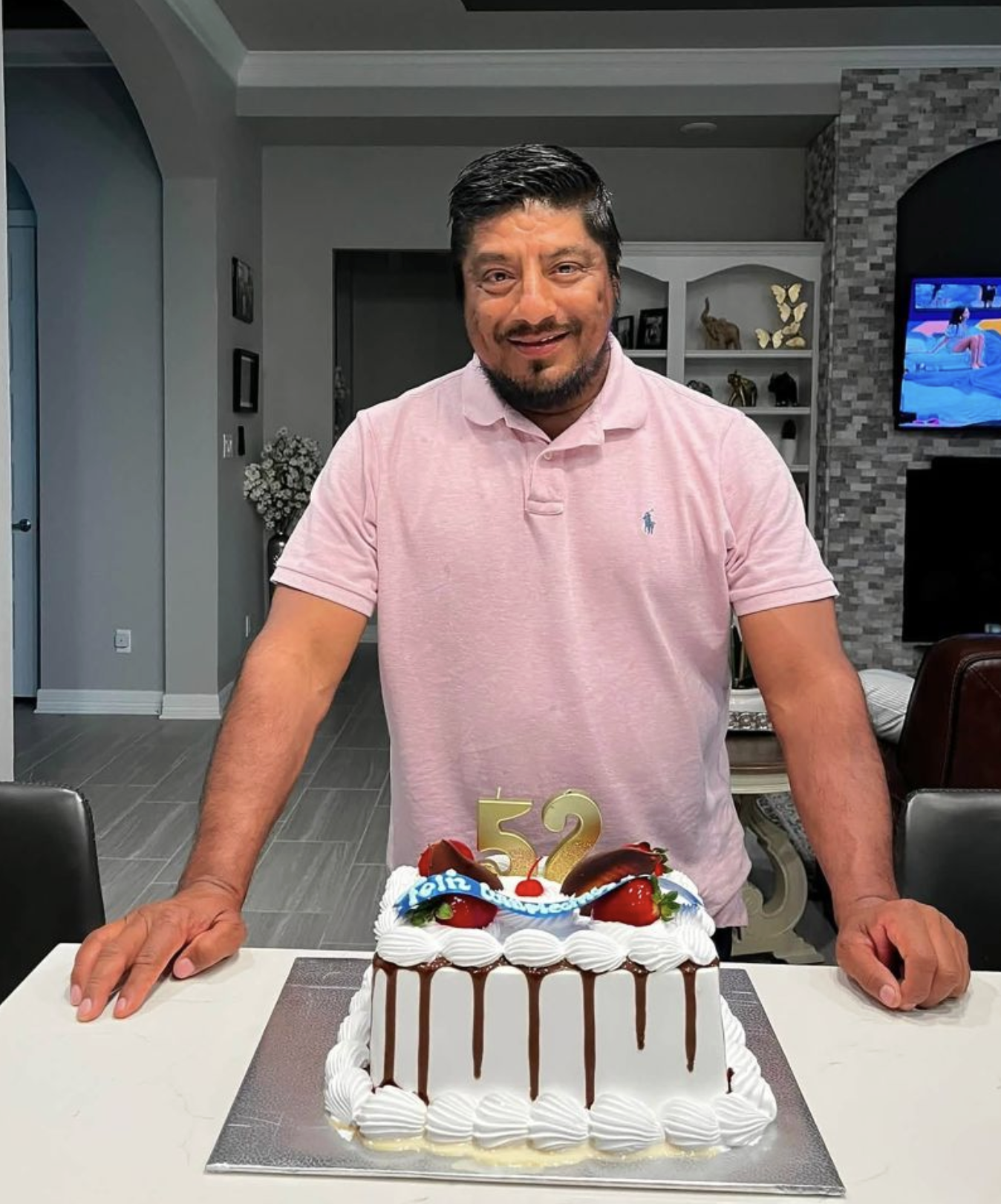
Immigration and Customs Enforcement agents shot and killed Lorenzo Salgado Araujo on the morning of Tuesday, July 7th, as he drove through Magnolia Park to pick up his construction crew, the same route he had driven for most of the nearly 35 years he lived in Houston.
He was a husband, a father of three U.S. citizens, and, in his son’s words, “a hardworking family man” and “a man of routine.”
Within hours, before the blood on Wayside and Canal was dry, the Department of Homeland Security had already pinned the blame on the dead man. They said he had “weaponized his vehicle.”
The federal government said the same thing when they gunned down Renée Good in Minnesota six months ago. They said the mother had “weaponized her vehicle” when an ICE agent shot and killed her in her car.
Same words. Same excuse. Another dead American.
Salgado Araujo’s killing was the second ICE-involved shooting that week alone, and that federal immigration agents have shot and killed at least ten people since the start of Donald Trump’s second term.
Consider the last morning of a man who did everything right for 35 years. His son, Ronaldo Salgado, laid it out minute by minute at a Wednesday news conference in Houston.
At 5 a.m., before the rest of the world stirred, Lorenzo Salgado Araujo brushed his teeth and showered while his wife cooked the meal he would carry to work. He got dressed, grabbed his lunch and coffee, hugged and kissed his wife goodbye, patted the family dog on the head, and drove off to gather his crew. He ended every day the same way, his son said, “sitting on the porch, eating a hearty meal made by my mother, going to sleep, and doing it all over again the next day.”
“He wanted nothing else in life but to provide for his wife and see his sons become great people,” Ronaldo said.
“At 6:45 a.m., he should have been picking up the last of his guys before heading to North Houston to finish up construction on some houses,” Ronaldo said.
Ten minutes later, near the intersection of Wayside and Canal, ICE agents in unmarked cars shot his father inside his van. Salgado Araujo was struck in the abdomen and pronounced dead at Harris Health Ben Taub Hospital, according to independent reporting. Ronaldo said the three other people in the van, including his uncle, were taken into custody and have not been heard from since.
So what kind of monster did ICE gun down? This weapon, this threat? Salgado Araujo built his own Houston home with the help of his crew. He had no criminal convictions in nearly 35 years in the country. PBS NewsHour reported that he was undocumented but actively pursuing legal status, that he had completed his biometrics and fingerprinting earlier in 2026, and that his work-permit paperwork was nearly complete. A source told CNN that Salgado Araujo was not even the target of the immigration operation that killed him. He was, in every sense that matters, a bystander in his own execution.
ICE tells it differently, of course. Following the shooting, the agency claimed Salgado Araujo had ignored verbal commands and rammed their vehicle, and that an agent fired on him in self-defense.
But how many times can the same story be told before it curdles into a lie? Renée Good, 37 years old, was shot and killed in her car in Minneapolis in January 2026. DHS alleged she, too, had “weaponized her vehicle.” Independent investigators disputed that characterization, Mother Jones reported, and the officer who killed her was never indicted. Before Good, there were Carlito Ricardo Parias and Marimar Martinez, both shot at by federal agents in 2025 and then accused of trying to ram those agents with their vehicles. Both survived to hear the accusation. Ruben Ray Martinez, shot by an ICE agent in March of 2025, did not. The agent who put a bullet through his heart said Martinez was using his car as a weapon.
The numbers do not describe a run of tragic accidents. They describe a script. A New York Times investigation found that U.S. police killed more than 400 unarmed drivers between 2015 and 2021, with officers again and again saying they fired because the vehicle itself was a weapon. Journalist Lila Hassan identified 18 ICE shootings involving a moving vehicle over that same period. Public records show ICE agents shot at least 59 people and killed at least 23 in those years, and not a single indictment came of it. Not one. Since that study, ICE’s budget has swelled by tens of billions of dollars while its internal oversight offices have been gutted. More money, less watching, more bodies. The killings have not stopped.
In the absence of the footage, advocates refuse to swallow the agency’s word. Roman Palomares, the national president of the League of United Latin American Citizens, known as LULAC, took the podium at Wednesday’s news conference and did not flinch.
“We are here today because in the absence of facts from Immigration and Customs Enforcement, ICE, we are left with no choice but to conclude that a man was unlawfully killed on the streets of Houston yesterday morning, barely 24 hours ago,” Palomares said. “Say his name because no one else, ICE, does not want you to say that name.”
Palomares aimed straight at the agency.
“It is unacceptable, it is un-American to use lethal force against a human being, then lock away the evidence, hide the video, silence the record, and expect his family, the people of Houston, and the American public to simply nod and say, we believe you, because we don’t,” he said. “You have not earned that trust. ICE has not earned that trust from the American people.”
Cesar Espinosa, executive director of the civil rights group FIEL, Immigrant Families and Students in the Fight, stood at that same news conference and later spoke with Democracy Now! from Houston. He said the family and the public have been left grasping at nothing.
“We don’t even know if there’s body cam footage that exists because ICE agents are not mandated to wear body cameras or have them running,” Espinosa said. “At the end of the day, the community, the family and the United States and every single person in this country deserves an answer.”
Why don’t people just stop? Why don’t they comply? Espinosa said he hears that question thrown around constantly, and he threw it right back. He asked listeners to picture themselves boxed in by unmarked vehicles on a dark morning street.
“These vehicles many times often start ramming vehicles, trying to get them to stop, trying to force them to stop,” he said. The agents who leap out, he said, are often in plain clothes with vests that say only “police,” no insignia marking them as federal agents or ICE, and that people have impersonated ICE agents.
“I cannot imagine the fear that a lot of people feel when they are being persecuted by somebody that’s unknown,” Espinosa said. “How would you react?”
The three men hauled from the van remain unaccounted for. Espinosa identified one as Salgado Araujo’s brother, Ronaldo’s uncle, and said the other two were strangers to him. Once immigrants vanish into the system, he said, locating them can take anywhere from 48 to 72 hours to sometimes weeks. And in that darkness, he said, family members are being leaned on go along with the government’s version of events.
“They’re being told to sign voluntary departures, they’re being told to, you know, cooperate with the version that ICE has released,” he said, adding that some had been threatened with charges or expedited deportation if they refused. “What we fear is that this is another effort from ICE to cover up something that they did very, very wrong.”
Espinosa tied the killing to a machine being built out in the open. He said that over the last year and a half, state troopers and forces directed by Texas Governor Greg Abbott, a Trump ally, have tried to emulate what the federal government is doing, and that reports of ICE sightings in the Houston area had spiked in recent weeks. It was, he suggested, only a matter of time.
“We must do everything we can to make sure that they get the transparency and justice that they deserve,” he said.
The city has turned the kill site into an altar. Click2Houston reported that hundreds gathered on Canal Street, leaving candles, flowers, handwritten notes and crosses, and that marchers chanted “ICE out of Houston.” Houston artist Sarah Fisher created a portrait built from dry-cleaning identification stickers arranged to spell “SOS” and “XOX,” which the outlet described as both a cry for help and a cry of love.
Ronaldo Salgado said he learned his father was dead from a video on social media. He recognized him, he said, “not from his appearance, but from his voice, crying for help as he lay on the street bleeding out.” His father, he said, “did not deserve to die,” and “did not deserve to be reduced to a headline of Mexican man shot and killed by ICE.”