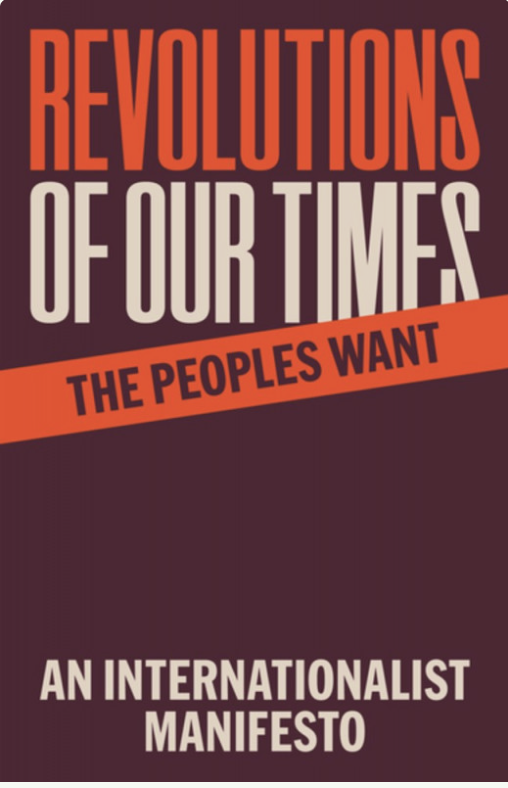
The Peoples Want Network plans to launch a transnational campaign it calls Mujawara in June, and the bet behind it is bold: that scattered, exhausted, struggles from Mexico to South Africa to Syria can be stitched into a single force before the next catastrophe arrives.
Speaking with The Final Straw Radio this month, two Peoples Want Network organizers - Rindala and Dozie said Mujawara is an Arabic word that translates to mean the act of “neighboring.”
Rindala and Doxie said the June campaign and the politics driving it as one of the most concrete ways the network has to practice an internationalism “from below.” The aim, Rindala said, is to link physical spaces — social centers, farms, libraries, coffee shops, and co-ops — to strengthen material solidarity across borders. It is open to people who are not network members, with participants they placed from Mexico to South Africa to Syria to Germany.
What does that look like on the ground? Whatever the people who show up decide it looks like.
“It could be a march. It could be a demo. It could be a fundraiser. It could be a barbecue. It can be painting a mural,” Rindala said.
Money raised will go to self-organized spaces, Rindala said — one in Syria and another channeled through the Syrian and Sudanese diaspora.
So what, exactly, are they building — and why now?
Rindala is Syrian and a member of the Peoples Want Network, and said that they have spent roughly the past 10 years in exile in France.
“After the fall of the regime in Syria I am trying to restart a life here in my hometown in Damascus,” Rindala said, speaking from Damascus.
Doxie is Egyptian, has lived in Berlin since 2014, and belongs to a leftist Egyptian organization in Germany “focused on addressing the socio-political challenges in Egypt” and on solidarity with struggles in Palestine, Sudan, and beyond.
The two said the network seeks to connect activists who took part in uprisings around the world over the past decade and a half, and to share the lessons of those movements among people trying to organize in their own communities.
A network born from a kitchen
The network has had a formal existence for about a year, Rindala said, but its roots reach back to 2019, a year described by Rindala as marked by another wave of uprisings — in Lebanon, Iran, Iraq, Algeria, Hong Kong, Chile, and Sudan.
At that time, Rindala was involved in a small collective called the Syrian Cantina, made up of Syrian exiles and internationalist activists from the French autonomous movement in the Parisian suburbs. Rindala described it as a popular kitchen and mutual aid space that doubled as a place of encounter between different communities.
When the collective set out to organize a solidarity event for Lebanese comrades in revolt, uprisings were erupting elsewhere, Rindala said. The first gathering took the famous Arab Spring slogan and made it plural — the Peoples Want — because, in Rindala’s words, organizers “felt that there was something that goes beyond the the specific national context of each uprising.”
What began as a one-day gathering grew over five editions into a 10-day festival, Rindala said, with three public days of concerts, exhibitions, film screenings, and debates, followed by roughly a week in which activists met privately to exchange experience and strategize. Participants came from more than 30 countries, Rindala said.
At its last edition, the network decided to organize itself more intentionally and to produce a text that could serve as a “political compass.”
The manifesto
That text, Revolutions of Our Times, an Internationalist Manifesto, has been published by Haymarket in the United States and the United Kingdom. It is also available as a PDF on the Peoples Want website in four languages: English, French, Spanish, and Arabic.
The manifesto traces its own origin to the summer of 2023, when, according to the document, nine people from different parts of the world — Lebanon, France, Syria, Tunisia, Chile, Kurdistan, and Iran — came together to establish a first draft. Each participant had taken part in the uprisings of their time. Later versions were circulated for discussion across distant places, the manifesto says, “from Santiago to Beirut, from Lyon to Buenos Aires, from the Massif Central to the Galloway Hills via the Beqaa Valley.”
The book opens with a prologue and moves through sections titled “recognising ourselves,” “birth of our power,” “finding the emergency break,” “turning exile into a position of attack,” “internationalism from below,” “the fall of Empire,” “revolution ?” and “starting over.” Rindala described the text as the sum of years of discussion at the festivals, and called the chapter on revolution one of the hardest to write.
The manifesto states its method plainly. “The revolutionary task has in part become a task of translation,” the text says, describing the sharing and translating of “different perceptions of reality” as the first steps in that method. It declares, “In revolt, we have regained our dignity,” and concedes the scale of what it proposes: “We are aware of the magnitude of the task.”
Doxie joined the network about two years ago, after its official establishment, when Doxie’s group was invited to the gathering in France.
Lessons from defeat
Who survives a revolution, and who is left to carry it? Both Doxie and Rindala spoke at length about the uprisings that shaped them — and about what came after.
Doxie took part in the Egyptian revolution of 2011, which began with a popular demand to take down the minister of interior before protesters discovered “they can really take down the president.”
Mubarak was ousted by the military in 18 days, after years of organizing and worker strikes, the biggest of which Doxie said took place in 2008. The rallying cry of the Egyptian revolution: “bread, freedom and social justice.”
A military council took power, followed by the election of Muhammad Morsi of the Muslim Brotherhood, whose presidency lasted about a year before a military coup. Doxie dated the end of the revolutionary wave to 2013 and 2014, and said repression afterward was not foreseen. By Doxie’s account, Egypt now holds — by “the most conservative estimate” — around 60,000 political prisoners.
Rindala was 17 when the Syrian revolution began and did not take part in protests, which Rindala described as highly secretive. Considering the brutality of the Assad regime, that’s not surprising. Rindala’s first contact, came through the harsh repression of friends in Damascus who did protest. She left the country in 2012 because of political repression of family members. Rindala said her efforts in the Syrian revolution unfolded in exile.
On-the-ground participation, Rindala said, came later — in the yellow vest movement in France in 2019. Rindala recalled telling French comrades who hesitated to join those protests: “what do you expect a revolution to look like.”
Doxie said the violence of the Syrian regime left Egyptian activists “in a state of shock,” even knowing the Assad government’s history. Doxie referred to an uprising in Hama in the 1980s in which, the regime killed around 40,000 people.
The manifesto casts this terrain as a contest over memory. Conservative and counter-revolutionary forces, the text says, are doing everything they can to portray “our uprisings as disasters, our rebels as terrorists and our achievements as failures.” Against that, it calls the creation of a common history, “weaving together all our accumulated experiences” is vitally important.
Refugees as revolutionary subjects
Can a person driven from home still be an organizer rather than only a victim? Rindala says yes, and the manifesto devotes a chapter to this topic.
Rindala pointed to what European officials and media called the refugee crisis of 2014 and 2015, when a million or more Syrians moved toward Europe. Much of the solidarity offered was “completely depoliticized and disconnected from the roots of exile” — treating the refugee as a subject needing charity rather than recognizing a “history of political struggle mobilization and knowledge.”
The aim, Rindala said, is “turning exile into a position of attack” and leaving behind a “victimhood narrative.” Rindala argued that the experience of the Syrian revolution gave exiles the readiness to read the yellow vest movement faster than some of their French counterparts.
Doxie said groups in Germany regained momentum after what the start of the genocide in Palestine, which “gathered a lot of like different diaspora groups together to work together.”
Why internationalism
“We know that if we remain isolated, we will achieve nothing.”
Why add the whole world’s struggles to a plate that already feels full? Doxie and Rindala acknowledged the objection — and answered it.
Rindala said internationalism can appear “counterintuitive,” but argued that the systems of “exploitation domination and repression” are themselves transnational, and that states and superpowers help one another defeat revolutionary movements regardless of ideology. Rindala described internationalism not as following every distant protest but as “a method” and “a practice” for analysis and shared strategy.
The manifesto makes the same claim in its own words. “We understood that we belong to a single transnational struggle and that we stand against an internationally organised elite,” the text says, adding: “We know that if we remain isolated, we will achieve nothing.”
Rindala cited the Syrian revolution as a case where, broader support — even seeds for besieged areas — was hard to secure, and asked whether a larger transnational movement “could not have reduced at least the bloodbath.”
Doxie said the Arab Spring “has failed in every country,” calling the failure “collective.” Doxie named Tunisia as the country activists once thought could survive, and said its fate was bound up with its neighbors. “Internationalism is not really a luxury,” Doxie said. “It’s like it is the method.”
The Mujawara campaign and the G20
The June 2026 campaign is the network’s wager that those lessons can be put into practice. Rindala built it around the network project Mujawara.
The manifesto frames this moment as one to seize. “Now is the time to extend and consolidate our connections,” the text says, predicting that circumstances will continue to deteriorate but that “tipping points of all kinds” will open opportunities for those who are ready.
Events can take any form, Rindala said, from a march to a barbecue to a mural. Funds raised will support self-organized spaces — one in Syria and another in either Sudan or another location — channeled through the Syrian and Sudanese diaspora.
Rindala said the network is on Blue Sky and Instagram, is rebranding its website, and lists a contact email there.