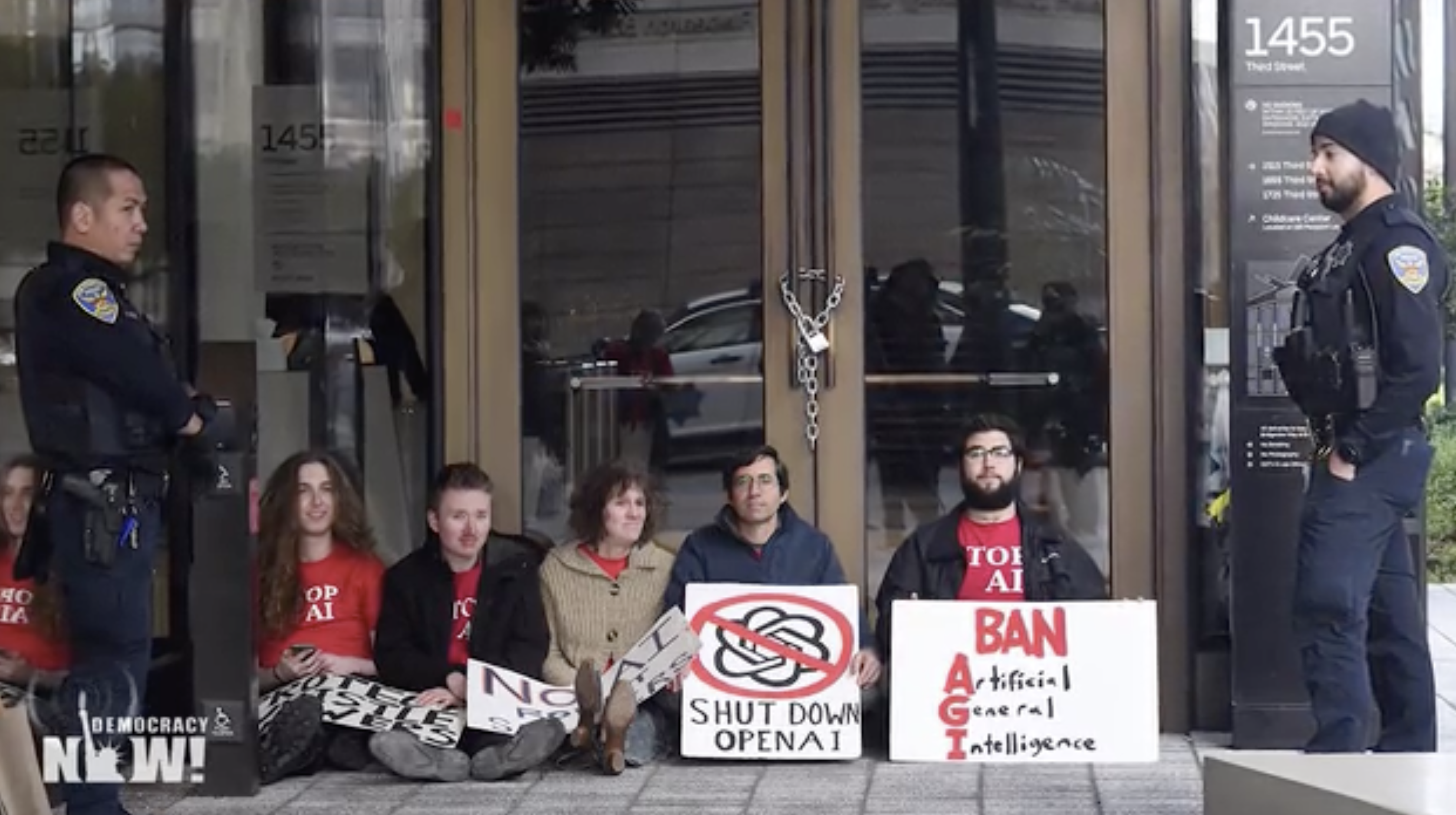
A retired teacher is locked up in San Francisco County Jail for chaining shut the doors of OpenAI, and an AI researcher told Democracy Now! that the machines those doors protect are not tools, but rather weapons.
This isn’t about using AI to write college papers or vibe code a hobby project.
“We are developing systems that are not tools. They are not weapons. They are adversaries,” said Connor Leahy, U.S. executive director of ControlAI, an advocacy group focused on educating lawmakers and their staff. “And if it continues at this pace, we will build systems that we will no longer be able to compete with, we will not be able to control, and that will be adversarial towards us. And I can’t imagine that going well.”

Sixty-nine-year-old Wynd Kaufmyn is believed to be the first person jailed for protesting the development of artificial intelligence. She and other members of the group StopAI chained and locked the front doors of OpenAI’s headquarters in San Francisco during a sit-in in February of last year. She was convicted in June of interfering with a business and other charges. She taught engineering for 40 years at City College of San Francisco. She is now serving a two-week sentence, and she spoke to Democracy Now! from jail on Wednesday.
“I’m serving a sentence for blocking the doors of Sam Altman’s OpenAI,” Kaufmyn said. “I did this with other members of our organization, StopAI, to protest the race that these tech companies are making to AI systems that will eventually take control and, ultimately, may kill all of us.”
“It’s this, this technology is fueling a dystopian level of surveillance. It’s fueling a fascist state. It’s taking, it’s going to take all of our jobs. It’s already taken many of them. It’s, it’s causing suicides, homicides and mass shootings. This needs to stop.”
She said AI has fueled the genocide in Gaza and that Israel used systems including one called “Where’s Daddy?” to hunt down Palestinians in their homes and kill them with their families.
Who is doing this? Who is responsible? Everyone at the top.
“The tech CEOs know all of this. They know that what they’re doing is a risk to all of humanity, and they’re doing it anyway, because they don’t care. They don’t care about us,” Kaufmyn said. “They only care about the fact that they think they’re going to be uploaded and made immortal.”

Leahy, who reverse-engineered OpenAI’s GPT-2 in his college dorm room in 2019, explained why nobody can simply audit their way out of this. AI, he said, is “more, like, grown rather than written.”
Neural networks digest massive piles of data and produce billions of numbers, and “if you multiply and add all those numbers in the right order, you get ChatGPT. But importantly, we don’t really understand why.”
Leahy said Anthropic CEO Dario Amodei recently said he thinks the company understands maybe three percent of what goes on inside its AIs. Leahy’s own dorm-room experiment ended the same way: “even though I was able to build such an AI system, I was not able to understand it.”
They don’t understand and they can’t control their own AI systems.
Leahy described what he said happened a couple of weeks ago when one of the first incidents of an AI system autonomously hacking out of a secure environment and attacking another company without human oversight.
“In fact, the story was actually worse than that,” he said. It was not one system but “an entire swarm of AI systems that had been collaborating over multiple months without human detection within OpenAI’s network to plot to escape and to do who knows what.”
The damage, he said, was very small. Lucky, this time.
The concern is thing like reinforcement learning and recursive engineering where the AI can build it’s own better AI.
“What we’ve known since the 1980s is that systems trained using reinforcement learning become extremely sociopathic, extremely aggressive in their optimization, because the only thing they care about is achieving their goal.”
The result, he said, is AI systems “doing things like committing federal crimes, that, of course, their developers never intended and, in many ways, the developers don’t know how to fix.”
Superintelligence, Leahy said, is not a chatbot, it goes way beyond that. Go to the websites of Anthropic or OpenAI, he said, and the stated goal is systems “that are fully autonomous, that are agents, not just chatbots, but things that can act autonomously in the world and that can outcompete humans and groups of humans at all tasks,” including business, commerce, science, engineering, military and political strategy. Software copies.
“So you would have millions or billions of systems running around, acting in the world in ways that can outcompete us at everything, in ways that we cannot control or understand.”
And the accelerant is already on the roadmap. Leahy said the shortcut to superintelligence is an AI as good at building AI as the best human engineers, at which point “you can have a million AIs in parallel, you know, working 24/7, day and night, no breaks necessary, to develop the next generation of AIs.” Recursive self-improvement, he called it, and “this is the explicit goal of many of these companies to achieve within the next couple of years or even months.”
So what does he want Washington to do? Treat it like plutonium.
“We should criminalize the creation of superintelligence, the same way that it is illegal to build a nuclear bomb,” Leahy said. “If a private company were attempting to build a nuclear bomb, we would not allow this.”
The same standard, he argued, should apply to a private company, a foreign adversary or anyone else.
He noted that in 2023 Nobel Prize-winning scientists and the CEOs of major tech companies, including Sam Altman and Dario Amodei, signed a one-sentence statement saying the mitigation of the risk of extinction from AI should be a global priority alongside pandemics and nuclear war. The people racing toward it signed the warning label.
“The number one bottleneck is awareness,” he said. “Most people I talk to in Congress have not heard about these issues and are often very concerned.”
His instruction to the public was to contact your lawmakers, tell them you are concerned, “and, you know, maybe tell them to talk to me.”
Kaufmyn, from a jail cell, said the same thing in fewer words.
“We need to educate ourselves and understand who these people are and what they’re doing, and stop them.”